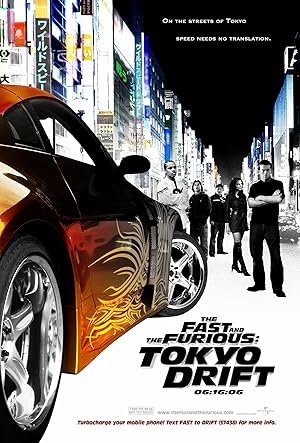
The Fast and the Furious: Tokyo Drift
Plot
An American teenager named Sean Boswell is a loner in school, however he challenges his rival for an illegal street racing, and he totals his car in the end of the race. To avoid time in prison he is sent to Tokyo to live with his father who is in the military. As soon as he arrives he discovers a new, fun but dangerous way of street racing in the underworld of the streets of Tokyo, Japan.
Get the Weekly Woke Watchlist
New and trending movies scored for woke bias, preachy messaging, and forced political themes — before you waste your evening.
No spam. One useful email per week.
Overall Series Review
Categorical Breakdown
The movie operates as a meritocracy where the protagonist, a white American, is initially the underdog and must earn his place in a Japanese subculture. Characters are judged by their ability to drive and their loyalty to the group. There is no vilification of whiteness or forced diversity quotas; the international cast fits the setting naturally.
The narrative highlights the discipline of the US military through the protagonist's father. While the film celebrates Japanese street culture, it does not do so by disparaging Western civilization or its history. The conflict is centered on personal rivalries and criminal elements rather than civilizational critique.
The film features traditional gender dynamics of the 2000s car scene. Women are largely portrayed as love interests or supporting figures in a male-dominated racing world. There are no 'Mary Sue' characters; the female lead has her own interests but does not overshadow or emasculate the male characters.
The movie adheres to a normative structure with a complete absence of queer theory or gender ideology. Relationships are exclusively heterosexual, and the concept of the nuclear family is respected through the protagonist’s relationship with his father.
Religion is not a central theme, but the film avoids hostility toward faith. It replaces moral relativism with a firm code of honor, respect, and consequences for one's actions. There is no mockery of traditional values or religious institutions.
Get the Weekly Woke Watchlist
New and trending movies scored for woke bias, preachy messaging, and forced political themes — before you waste your evening.
No spam. One useful email per week.