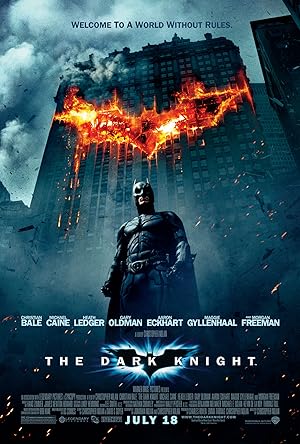
The Dark Knight
Plot
Set within a year after the events of Batman Begins (2005), Batman, Lieutenant James Gordon, and new District Attorney Harvey Dent successfully begin to round up the criminals that plague Gotham City, until a mysterious and sadistic criminal mastermind known only as "The Joker" appears in Gotham, creating a new wave of chaos. Batman's struggle against The Joker becomes deeply personal, forcing him to "confront everything he believes" and improve his technology to stop him. A love triangle develops between Bruce Wayne, Dent, and Rachel Dawes.
Get the Weekly Woke Watchlist
New and trending movies scored for woke bias, preachy messaging, and forced political themes — before you waste your evening.
No spam. One useful email per week.
Overall Series Review
Categorical Breakdown
The narrative centers on character merit and philosophical conviction, not on immutable characteristics or identity hierarchy. The primary protagonists, Batman/Bruce Wayne, Harvey Dent, and James Gordon, are judged entirely on their actions and moral integrity. Key supporting characters like Lucius Fox are in positions of high authority based on their professional competence. The core conflict is fundamentally universal and colorblind.
The movie champions the preservation of Gotham City's civil order and institutions. The main hero sacrifices everything to protect the faith citizens have in their society and its 'White Knight,' Harvey Dent. The villain is the ultimate agent of chaos and civilizational deconstruction, whose nihilistic attempts to corrupt society are ultimately resisted by the collective choice of the city's populace. The film's message validates the need for a shield against chaos.
The female lead, Rachel Dawes, is a strong-willed, competent prosecutor. However, her character functions mainly as the emotional anchor and tragic catalyst for the male leads (Bruce Wayne and Harvey Dent). Her story and death exist to propel the men's moral and emotional journeys. The gender dynamics are traditional, focusing on a love triangle and the masculine ideal of a protector who must forgo domestic life for his duty, without promoting modern 'Girl Boss' or anti-natalist messages.
The film does not contain any explicit LGBTQ+ representation or themes. The central romantic plot involves a traditional male-female pairing. Sexuality is not centered as a primary trait, and the narrative does not introduce or lecture on queer theory or gender ideology. The structure remains strictly normative.
The movie is a profound debate against moral relativism. The Joker embodies moral nihilism and anarchy, arguing that all human morality is a 'bad joke' dependent on circumstance. The heroes, particularly Batman and the citizens in the ferry sequence, ultimately choose actions rooted in objective moral law and self-sacrifice. The narrative strongly champions a transcendent moral order over the subjective chaos promoted by the villain.
Get the Weekly Woke Watchlist
New and trending movies scored for woke bias, preachy messaging, and forced political themes — before you waste your evening.
No spam. One useful email per week.