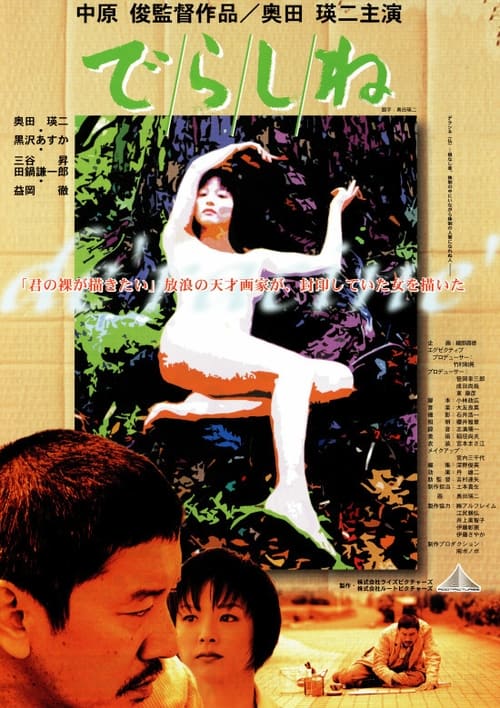
Déracine
Plot
A mysterious street-painter, Jouji, wanders aimlessly, homeless. Together with his homeless pals, he makes his living by selling his paintings on the street. His paintings, dynamically exploding on pieces of cardboard, catch the eyes of Kyoko, an art dealer. He can feel alive only if he keeps painting, but unable to find something to fill his void inside, he tries to drown himself in alcohol. Drawn to Jouji, Kyoko commissions him to paint for her. The two travel to a secluded mountain-side, and there Jouji becomes inspired both by the natural surroundings and Kyoko herself.
Get the Weekly Woke Watchlist
New and trending movies scored for woke bias, preachy messaging, and forced political themes — before you waste your evening.
No spam. One useful email per week.
Overall Series Review
Categorical Breakdown
The plot is entirely focused on personal struggle and artistic merit. Jouji, a homeless man, is noticed and given an opportunity based on the quality of his paintings, illustrating a principle of universal meritocracy. There is no evidence of the narrative relying on race, immutable characteristics, or vilification of any group, only the personal void of the artist.
The narrative makes no attempt to vilify Japanese culture, institutions, or ancestors. Jouji’s 'void inside' is a personal crisis, not a societal one. The move to a secluded mountain-side suggests a search for peace and inspiration in nature, which is a return to natural surroundings rather than an indictment of his home culture.
Kyoko is an art dealer, a professional, which elevates her from a purely supportive role. However, her primary narrative function is to commission Jouji's work and act as an inspiration, helping him overcome his addiction. This establishes a distinct but complementary dynamic: she is the professional/muse, and he is the raw, troubled talent. The plot does not depict males as bumbling or toxic, only troubled, and Kyoko is not presented as a perfect, instantly successful 'Mary Sue.'
The central relationship is a traditional male-female pairing between the artist Jouji and the dealer Kyoko. There is no indication of centering alternative sexualities, deconstructing the nuclear family, or lecturing on gender theory. The focus is on their professional connection and personal inspiration.
The core conflict is Jouji's internal 'void' and his attempt to 'drown himself in alcohol.' The resolution comes from art, nature, and human connection (Kyoko). The narrative is secular, focusing on personal, existential angst, and finds a form of spiritual solution in art and the transcendent beauty of the natural world. No hostility toward religion is displayed; the themes operate on a completely separate, non-theistic plane.
Get the Weekly Woke Watchlist
New and trending movies scored for woke bias, preachy messaging, and forced political themes — before you waste your evening.
No spam. One useful email per week.