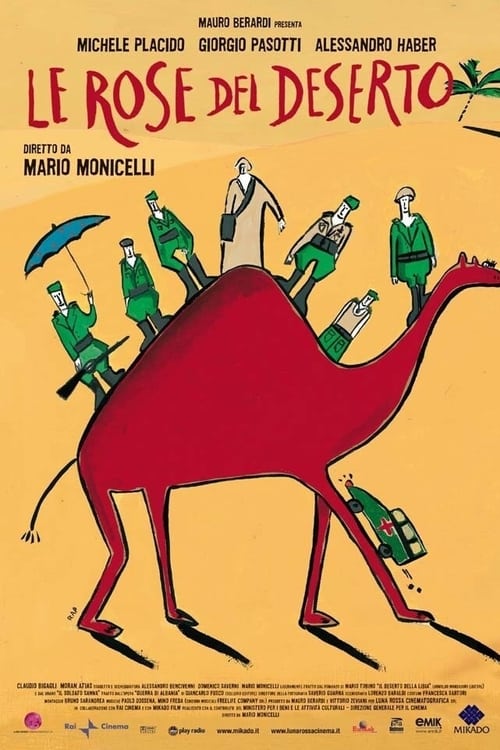
The Roses of the Desert
Plot
A sanitary battalion of Italian Army is sent to Sorman oasis in Lybia during the Africa campaign in 1940. Soon an Italian missionary, living nearby, succeed to transform the occupation by Italian Army in a kind of humanitarian mission. In fact all the battalion is involved to help the local population. The war anyway goes on with no regards to human feelings. The "glorious" Fascist campaign is going to became a fast retreat.
Get the Weekly Woke Watchlist
New and trending movies scored for woke bias, preachy messaging, and forced political themes — before you waste your evening.
No spam. One useful email per week.
Overall Series Review
Categorical Breakdown
The narrative centers the local North African civilization as the site of authentic human connection and rich culture, contrasting it with the Italian occupying force. This leans into the 'Noble Savage' trope by depicting the local 'Other' as superior to the European 'Self.' The critique is aimed at the Fascist ideology and military incompetence, not a broad vilification of 'whiteness,' and no race-swapping or intersectional hierarchy is present.
The film strongly criticizes the Italian military and the Fascist campaign, depicting the 'glorious' war as a debacle and retreat. The soldiers view their army's general staff as preposterous and confirm that the 'mirage' lies with the home country, not the desert. This expresses hostility toward the soldiers' own home-nation's institutions and military actions, embracing the opposing culture as a preferred alternative to the chaos and corruption of the ancestral state.
Gender dynamics are traditional, focusing on a male military unit and a male friar. The primary female character, the Major's wife, is only significant through her infidelity, which triggers a male character's personal tragedy. The narrative contains no 'Girl Boss' tropes, no explicit anti-natalist messaging, and no general emasculation of the men, who are characterized by their camaraderie and abandonment of the military role.
The narrative contains no centering of alternative sexualities, no deconstruction of the nuclear family, and no introduction of gender ideology. The familial and sexual themes are exclusively centered on traditional male-female pairings, such as the Major's love for his wife and the Lieutenant's interest in local women.
An Italian Franciscan friar is a central and positive moral figure who is responsible for turning the military occupation into a humanitarian mission. The film explicitly shows Catholics and 'Allah's followers' joining together in 'prayer and solidarity,' portraying religious faith as a unifying, moral force for good rather than a source of evil or bigotry.
Get the Weekly Woke Watchlist
New and trending movies scored for woke bias, preachy messaging, and forced political themes — before you waste your evening.
No spam. One useful email per week.