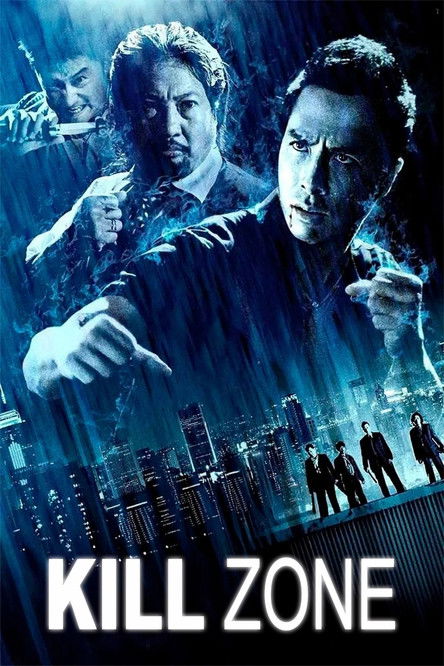
SPL: Kill Zone
Plot
Chan, an articulate senior detective nearing the end of his career, is taking care of the daughter of a witness killed by ruthless crime lord Po. Martial arts expert Ma is set to take over as head of the crime unit, replacing Chan who wants an early retirement.
Get the Weekly Woke Watchlist
New and trending movies scored for woke bias, preachy messaging, and forced political themes — before you waste your evening.
No spam. One useful email per week.
Overall Series Review
Categorical Breakdown
The film’s central conflict is a moral and professional battle between men on opposite sides of the law, who are all part of the same Chinese cultural context. Character competence is judged exclusively by martial arts skill and tactical ability, such as the martial arts expert Ma being a 'badass' investigator and the triad boss Po being an Acrofatic fighter. The narrative completely avoids any discussion of race, intersectional hierarchy, or the vilification of any ethnic group; the focus is solely on universal themes of justice and corruption.
The setting is the Hong Kong police force and criminal underworld, which presents a grim view of institutional corruption and moral decay within the home culture. However, this is an internal critique of integrity, not a self-hatred that elevates an 'alien' culture. The film is philosophically anchored in a traditional Chinese metaphysical concept—the belief in *karma* and the 'Sha Po Lang' (Seven Killings, Breaker, Greedy Wolf) astrological stars—which grounds the tragedy in a domestic, ancestral moral framework.
The main cast and dramatic focus are overwhelmingly male, centering on the conflicts between the policemen and the triad members. Female characters are extremely minimal, with the most significant being a young daughter who serves as the moral anchor for a male character, and the triad boss’s wife, whose miscarriage highlights the villain's paternal and natal desires. There are no 'Girl Boss' or 'Mary Sue' tropes, nor is there any anti-natal or anti-family messaging; familial bonds and protective masculinity drive the core motivation for the lead detective.
The narrative contains no LGBTQ+ characters, themes, or ideological messaging. Sexual identity is entirely absent from the plot, which focuses on the hyper-masculine world of police and crime. The nuclear family structure, represented by Inspector Chan's protective relationship with his adopted daughter and Wong Po's marriage, is presented as the default, normative structure of society.
The film does not target traditional religion, particularly Christianity. Instead, it embeds its entire thematic structure in a non-Abrahamic, transcendent moral law by explicitly referencing the Chinese concept of *karma* and fate, with a key line stating, 'God is fair'. This spiritual framework provides a clear, objective moral consequence for the actions of both the corrupt cops and the criminals, directly opposing the idea of subjective 'power dynamics' or moral relativism.
Get the Weekly Woke Watchlist
New and trending movies scored for woke bias, preachy messaging, and forced political themes — before you waste your evening.
No spam. One useful email per week.