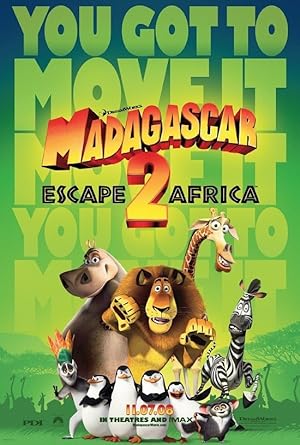
Madagascar: Escape 2 Africa
Plot
The sequel to 2005's "Madagascar", in which New York Zoo animals, Alex the Lion, Marty the Zebra, Melman the Giraffe and Gloria the Hippo, still stranded on Madagascar, start to leave the island. All of a sudden, they land in the wilderness of Africa, where Alex meets the rest of his family, but has trouble communicating with them after spending so much time at the Central Park Zoo.
Get the Weekly Woke Watchlist
New and trending movies scored for woke bias, preachy messaging, and forced political themes — before you waste your evening.
No spam. One useful email per week.
Overall Series Review
Categorical Breakdown
The main conflict is centered on Alex's identity, which pits the 'civilized' New York showman against the 'ancestral' African lion, suggesting merit is found outside immutable, traditional roles. Marty's crisis revolves around the inability of others to distinguish him from a herd of zebras, which is used as a commentary on the lack of appreciation for individual identity. Gloria's romantic choice of Melman (a giraffe) over Moto Moto (a hippo of her 'own race') is noted by some analysts as subverting a racial preference.
The film contrasts the New York lifestyle with the African wild, but does not depict the Western 'home culture' as fundamentally corrupt; instead, it shows the New York group's resourcefulness and skill are necessary to solve the African animals' problem (the water crisis). The villain Makunga is an opportunist who uses a rigged 'ancestral' tradition (the fighting challenge) to gain power, which frames the institution of traditional leadership and heritage as susceptible to corruption. Overall, the theme leans toward the value of the 'zoo' education over the 'wild' tradition, but it does not demonize ancestors.
Gloria the hippo is a highly confident and self-assured character who dictates the terms of her romantic relationships. Her ultimate choice rejects the hyper-masculine 'Chad' archetype, Moto Moto, in favor of the sensitive, devoted, and domestically-inclined Melman, which elevates a softer form of masculinity. The 'Chimp Power' subplot involves the female-coded chimpanzees going on strike for maternity leave, a clear injection of workplace feminist politics into a comedic setting.
The King Julian character is noted by some commentary as a metaphor for 'gay rights' and is flamboyant in his mannerisms. He makes an explicit joke, stating, 'I'm a woman! Which one of you is attracted to me?' which introduces gender-fluidity language into a children's film context for a laugh. Alex's struggle between performing (dancing) and fighting is analogized as a 'Coming-Out Story,' but the themes are not centered around sexual identity or deconstructing the nuclear family, which remains the aspirational structure for Alex's parents.
The main satirical element involves King Julian exploiting the African animals' desperation for water by instituting a cult-like sacrifice ritual, framing their 'spiritual' traditions as nonsensical superstition and a vehicle for a dictator's power. One analysis suggests the film depicts African spirituality as 'superstition and inferiority.' The film's 'solution' to the water crisis is a practical, secular fix (the penguins and chimps blowing up a dam) rather than a spiritual one, positioning rational action as superior to traditional belief.
Get the Weekly Woke Watchlist
New and trending movies scored for woke bias, preachy messaging, and forced political themes — before you waste your evening.
No spam. One useful email per week.