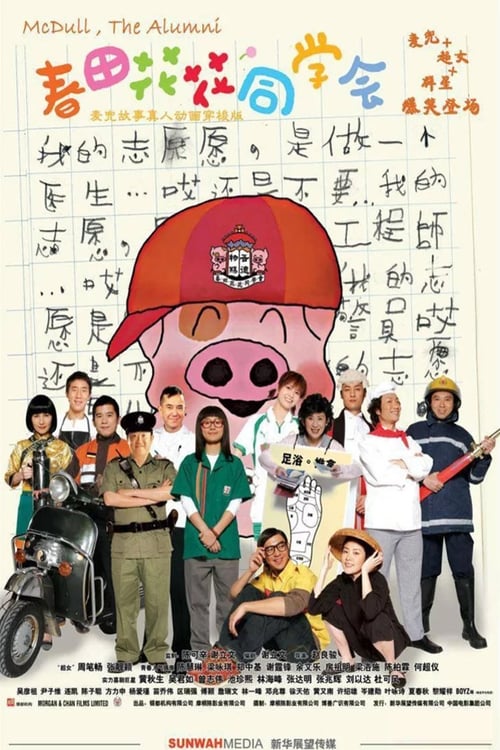
McDull, the Alumni
Plot
In McDull, the Alumni, our protagonist has grown up. He is no longer the little boy who banters with his mates at school. How he wishes he could just go on bantering all day long with his mates at the renowned Flower on the Spring Field Kindergarten. But that is not to be. Like all grown-ups, he has to grapple with harsh reality. McDull and his mates are scattered all over the place. Each one of them has to find his or her own path. In each of their hearts, they know they have failed. Meanwhile, life goes on in the kindergarten. Someone strums a guitar and the pupils chime in to the song: Puff the magic dragon, lives by the sea… A dragon lives forever, but not so little boys. With hindsight, McDull believes this could well be the maxim of the Flower on the Spring Field Kindergarten alumni.
Get the Weekly Woke Watchlist
New and trending movies scored for woke bias, preachy messaging, and forced political themes — before you waste your evening.
No spam. One useful email per week.
Overall Series Review
Categorical Breakdown
Characters are judged based on their success or failure in the capitalist job market, which is a measure of merit and circumstance, not on immutable characteristics or race. The film’s focus is on class and economic reality, not an intersectional hierarchy. The cast is ethnically congruent with the film’s Hong Kong setting.
The film does not promote hostility toward its own civilization or ancestors. It functions as a satirical critique of the socio-economic pressures and 'absurdities' of modern Hong Kong working life. The narrative is intensely local, celebrating its own culture, slang, and locations, which is the opposite of civilizational self-hatred. It critiques the system but not the underlying culture.
Gender roles are not a central theme. The satire is aimed at the shared failure of both male and female alumni in the post-graduation job market. The mention of McDull wanting to be an 'office lady' is used for whimsical, non-political humor, not to critique or deconstruct gender. There is no evidence of a 'Girl Boss' trope or anti-natalist messaging; the focus is on career aspirations and adult reality for all.
The film is focused exclusively on the universal themes of nostalgia, economic struggle, and adult disappointment. The plot and reviews do not indicate any presence of a queer theory lens, centering of alternative sexualities, or deconstruction of the nuclear family.
The film is primarily a social satire and a work of melancholy nostalgia. The core message is bittersweet and focused on human experience and the loss of childhood dreams. There is no open hostility toward religion, nor is there an espousal of moral relativism over a transcendent moral law.
Get the Weekly Woke Watchlist
New and trending movies scored for woke bias, preachy messaging, and forced political themes — before you waste your evening.
No spam. One useful email per week.