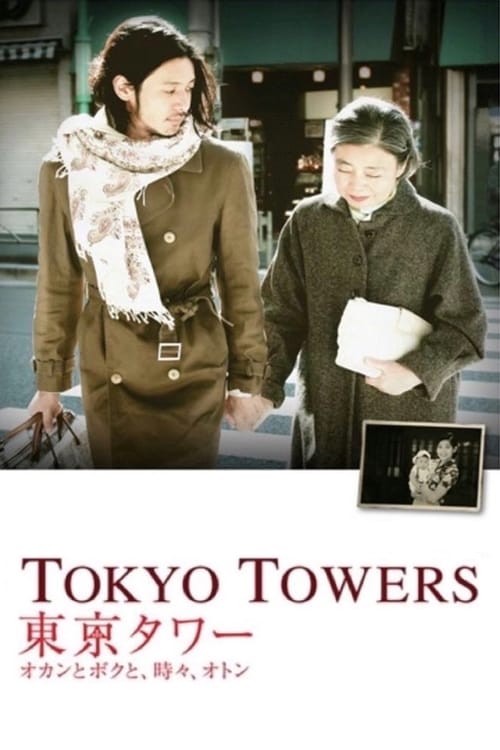
Tokyo Towers: Mom and Me, and Sometimes Dad
Plot
Adapted from the bestselling Japanese autobiography of the same title, this gentle coming-of-age drama concerns an adolescent boy, Boku - Masaya, torn between the inherited recklessness of his father Oton and the inherited responsibility, wisdom and emotional strength of his mother Okan. Following a period of intensely rebellious behavior, Boku learns that his mom has contracted cancer; suddenly, his mother comes to live with him in Tokyo the entire emotional landscape of his life is altered.
Get the Weekly Woke Watchlist
New and trending movies scored for woke bias, preachy messaging, and forced political themes — before you waste your evening.
No spam. One useful email per week.
Overall Series Review
Categorical Breakdown
Characters are judged solely on personal actions and moral content, such as the son's immaturity and the mother's emotional strength. The plot is a personal coming-of-age and family drama; it does not introduce race or immutable characteristics as a factor for systemic conflict. Casting is authentically Japanese, consistent with the source material and setting, demonstrating colorblind execution.
The film centers on the core institution of the Japanese family and celebrates the profound sacrifice and dedication of the mother. The narrative avoids framing Japanese culture or society as fundamentally corrupt or racist. The film’s emotional core is gratitude toward an ancestor (the mother), which stands as the opposite of self-hatred.
The mother is the emotional and moral rock of the family, embodying emotional strength and wisdom. Her role as a devoted parent who sacrificed for her son is celebrated as noble, which directly contradicts anti-natal messaging. The father is flawed due to his own recklessness and alcoholism, not simply because he is male, and the mother's strength is protective and nurturing, not a perfect 'Girl Boss' trope that seeks to emasculate all men.
The story adheres strictly to a normative family structure, focusing on the traditional male-female pairing in the form of the separated parents and the relationship between a mother and her son. There is no presence of alternative sexual ideologies, nor is there any attempt to deconstruct the nuclear family unit as an oppressive structure. Sexuality is private and not a central theme.
The core themes are a pursuit of transcendent love, familial duty, and a confrontation with the objective truth of mortality and moral responsibility. The film's emotional depth acknowledges a higher moral law in the form of a son's duty and a mother's unconditional love. There is no hostility toward or critique of traditional religion in the narrative.
Get the Weekly Woke Watchlist
New and trending movies scored for woke bias, preachy messaging, and forced political themes — before you waste your evening.
No spam. One useful email per week.