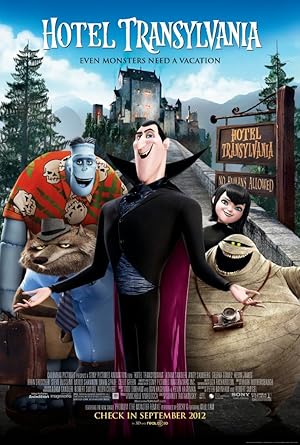
Hotel Transylvania
Plot
In 1895, Dracula builds a resort in Transylvania, hidden from the humans, to raise his beloved daughter Mavis in a safe environment. In the present, the place is the Hotel Transylvania, where monsters bring their families to vacation far from the frightening humans. Dracula invites his friends - Frankenstein and his wife Eunice; Wayne and Wanda, the werewolves; Griffin, the invisible man; Murray, the mummy; Bigfoot, among others - to celebrate the 118th birthday of Mavis. When the party is ready to start, the 21-year-old Jonathan is walking through the forest and stumbles upon the hotel. Dracula sees Jonathan and disguises him as a monster to hide Jonathan from the guests. But Mavis also sees Jonathan and Dracula forces him to pose as a monster. Soon Mavis believes that Jonathan is the "zing" of her life despite the advice of her father about humans.
Get the Weekly Woke Watchlist
New and trending movies scored for woke bias, preachy messaging, and forced political themes — before you waste your evening.
No spam. One useful email per week.
Overall Series Review
Categorical Breakdown
The main plot exists to resolve a conflict based on immutable characteristics. Monsters are clearly allegorical for a marginalized minority group who have historically suffered persecution and discrimination from bigoted humans. The hotel serves as a safe space for this minority. The narrative's central movement is the hero abandoning his 'age-old prejudice' to accept the human 'other,' making the message a direct lecture on overcoming bigotry and embracing diversity.
Dracula’s entire home, the hotel, is a fortress built upon a fear-based, exclusionary heritage of isolation from humanity. The narrative frames this traditional, ancestral protection as misguided and based on an outdated injury. The younger generation seeks to leave this isolated, 'corrupt' home for the outside human world, which is ultimately depicted as more evolved and accepting. The hero must abandon his old way of life to achieve the film's positive resolution.
Mavis, the female lead, displays strong independence by actively challenging her father's rules to seek freedom and experience the world. However, her primary ambition is finding 'zing' (true love) and marriage, with a maternal message from her dead mother reinforcing this goal. The story's emotional focus centers on the bonding and quest of the two main male characters, Dracula and Jonathan, rather than Mavis's individual arc or professional aspiration.
The core of the movie revolves around the romantic pairing of a male and female, Jonathan and Mavis, centered on the 'zing' (love at first sight) concept. The supporting monster characters are shown as traditional, married couples with children. The film consistently reinforces the male-female pairing and nuclear family structure without including any alternative sexualities or gender theory concepts.
The conflict is based purely on social prejudice and historical violence between monsters and humans. The antagonistic humans are depicted only as a bigoted mob. The movie contains no religious figures, mockery of faith, or any thematic discussion of traditional religion. The story promotes the objective moral truth that prejudice and hatred are wrong, which runs contrary to moral relativism.
Get the Weekly Woke Watchlist
New and trending movies scored for woke bias, preachy messaging, and forced political themes — before you waste your evening.
No spam. One useful email per week.