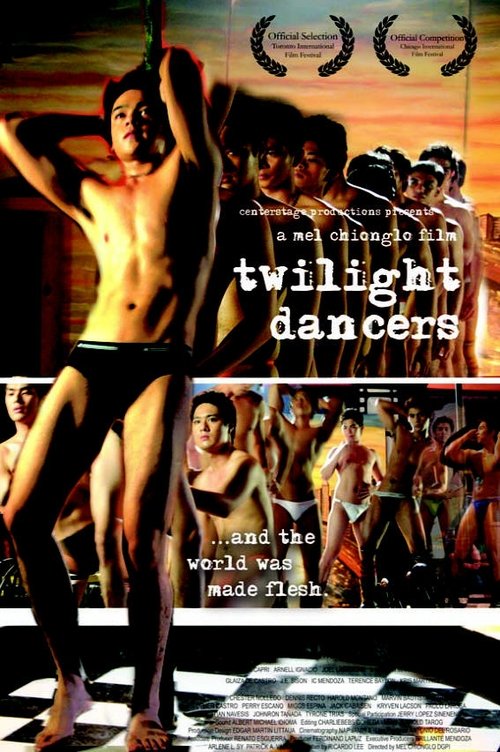
Twilight Dancers
Plot
Current most popular performer at a gay club in the Philippines (though it’s patronized by an awful lot of ogling straight women), Dwight (Tyron Perez) has a crush on a collegiate girl and an eye on better prospects working abroad. But he unwisely gets involved with boytoy-hungry Madame Loca (Cherry Pie Pichache), a ruthless, corrupt businesswoman. Her disillusioned ex-dancer bodyguard Bert (Lauren Novero) tries in vain to warn Dwight. Meanwhile, past-prime-at-28 Alfred (Allen Dizon) struggles to find legit work to support his wife and child.
Get the Weekly Woke Watchlist
New and trending movies scored for woke bias, preachy messaging, and forced political themes — before you waste your evening.
No spam. One useful email per week.
Overall Series Review
Categorical Breakdown
The film’s central conflict is based on class struggle and economic vulnerability, with marginalized male dancers fighting against a corrupt local elite. The narrative does not employ an intersectional lens to lecture on global privilege or vilify 'whiteness' since the story is entirely focused on a Filipino subculture and its internal class/power dynamics. Character outcomes are determined by local social and political pressures, not a prescribed identity-based moral hierarchy.
The movie is a direct and pointed critique of corruption within its home nation's political and social systems. The focus is on localized Philippine problems like venal politicians and business crime. This internal critique of the local establishment does not translate into hostility toward Western civilization, its core institutions, or its ancestors, which are the specific targets of the Oikophobia definition.
Gender dynamics feature a powerful female antagonist, Madame Loca, who is a ruthless, corrupt, and manipulative businesswoman. She exerts control and power over the male leads, representing a dominant female figure who is nonetheless a villain, complicating the 'Girl Boss' celebration. The narrative shows a dancer struggling to maintain a traditional family unit by supporting his wife and child, though the wife expresses agency by rejecting her husband's profession.
The plot's setting is intrinsically a gay club, and the livelihood of the main characters, the macho dancers, is centered around alternative sexualities and gender performance. The inclusion of a transvestite performer and a cross-dressing mayor further solidifies that non-traditional sexual identity and expression are foundational, normalized, and central elements of the narrative's world and conflict.
The focus on economic survival, social corruption, and the exploitative nature of the sex work industry establishes an environment of practical moral relativism. The narrative's attention to material and carnal desire does not include any explicit demonization of traditional religion, nor does it feature religious characters as villains or bigots lecturing against faith.
Get the Weekly Woke Watchlist
New and trending movies scored for woke bias, preachy messaging, and forced political themes — before you waste your evening.
No spam. One useful email per week.