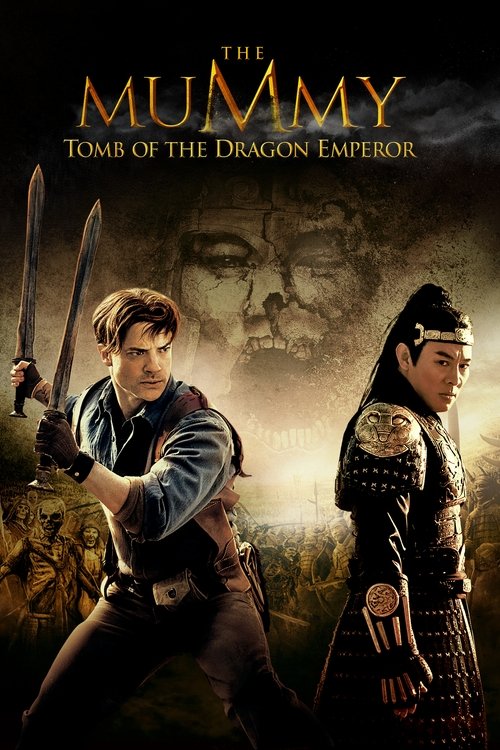
The Mummy: Tomb of the Dragon Emperor
Plot
Archaeologist Rick O'Connell travels to China, pitting him against an emperor from the 2,000-year-old Han dynasty who's returned from the dead to pursue a quest for world domination. This time, O'Connell enlists the help of his wife and son to quash the so-called 'Dragon Emperor' and his abuse of supernatural power.
Get the Weekly Woke Watchlist
New and trending movies scored for woke bias, preachy messaging, and forced political themes — before you waste your evening.
No spam. One useful email per week.
Overall Series Review
Categorical Breakdown
The narrative focuses on a struggle between a tyrannical Chinese emperor and a coalition of white Westerners and heroic Chinese characters. The main conflict is based on an ancient power struggle, not on modern race or privilege dynamics. White main characters are not portrayed as incompetent or evil; they are the heroic family unit. The Chinese villain's evil is personal and megalomaniacal, not a condemnation of Chinese identity or history in general. Merit dictates the effectiveness of all characters.
The movie demonstrates hostility toward a tyrannical figure from ancient Chinese history, the Dragon Emperor, not Western civilization. Western heroes join forces with Chinese heroes to protect the world. The film is set in China, celebrating an adventure rooted in Chinese mythology and ancient cultural concepts (like the Terracotta Army and Shangri-La). There is no narrative framing that suggests Western culture is fundamentally corrupt or inferior to an idealized 'Other.'
Evelyn is a competent and successful adventure novelist who is also a wife and mother, demonstrating that career and family are compatible. The most powerful characters in the narrative are the sorceress Zi Yuan and her immortal daughter Lin, who perform acts of great strength and sacrifice. Their power is derived from ancient magic and a family lineage, not an ideological 'Girl Boss' trope. Their actions are driven by love and a desire to protect the world, representing a complementary view of gender roles where women are vital and powerful.
The core of the emotional story revolves around the traditional male-female pairing of Rick and Evelyn, and the emerging heterosexual romance between their son Alex and the Chinese heroine Lin. The nuclear family unit is the central heroic structure of the film. Sexual expression is private and traditional, with no presence of alternative sexual ideologies, deconstruction of the family, or gender theory lecturing.
The movie's moral universe is based entirely on a pagan/occultic framework involving ancient Chinese sorcery, curses, and resurrection. This fantasy structure implicitly rejects a Christian, Biblical worldview, as it uses an alternate, non-Abrahamic mythology as its source of spiritual truth and power. However, it does not explicitly attack or vilify Christian characters or institutions; it simply operates in a completely separate, magic-based domain of morality and power, acknowledging a higher moral law through a mythological lens.
Get the Weekly Woke Watchlist
New and trending movies scored for woke bias, preachy messaging, and forced political themes — before you waste your evening.
No spam. One useful email per week.