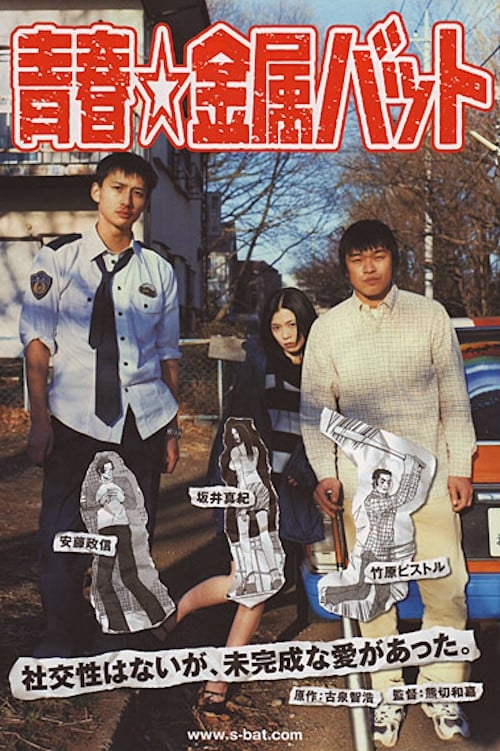
Green Mind, Metal Bats
Plot
The film follows Nanba, a shunned outcast who doesn’t have a girlfriend, any money or prospects, a turnaround from his glory days in high school when he played on the baseball team; his former teammate Ishioka, who is now a policeman because of an elbow injury; and baseball fanatic Eiko, a hopeless alcoholic who spends more of her time drunk than sober. The three share an intense love of baseball — and their destinies are forever intertwined.
Get the Weekly Woke Watchlist
New and trending movies scored for woke bias, preachy messaging, and forced political themes — before you waste your evening.
No spam. One useful email per week.
Overall Series Review
Categorical Breakdown
The film is Japanese and does not engage with Western-centric race politics or the vilification of 'whiteness.' Characters are defined by their personal failures, such as Nanba's lack of prospects and Ishioka's career-ending injury, focusing on a universal struggle with meritocracy and lost dreams, not an intersectional hierarchy based on immutable traits. Character judgment rests entirely on individual actions and internal despair.
The movie is a critique of personal and existential malaise rather than a full-scale civilizational attack on Japanese culture or ancestors. While the characters are social outcasts and their lives are chaotic, the narrative is not a lecture framing the home culture as fundamentally corrupt or racist. The characters' alienation is personal and emotional, not a philosophical indictment of the nation's core institutions.
The primary female lead, Eiko, is portrayed as a deeply flawed and non-aspirational character who is an 'abusive drunk' and a 'hopeless alcoholic.' She is not a 'Girl Boss' or a 'Mary Sue' who is instantly perfect. Her relationship with Nanba is chaotic, with her using him for money and physical needs. The narrative presents a destructive relationship dynamic rather than a message of female supremacy or male emasculation.
The core relationships are heterosexual, focusing on Nanba's inability to get a girlfriend and Ishioka's status as a married man. The film's themes are centered on sports obsession, failure, crime, and alcoholism. No part of the narrative or character development focuses on alternative sexual identities, deconstructing the nuclear family, or advancing gender ideology as a central political theme.
The film's primary spiritual element is a secular, mythological obsession with baseball, personified by the appearance of a character called 'the spirit of Babe Ruth' or 'Son of Babe Ruth.' The narrative does not contain any hostility toward traditional religion, nor does it feature Christian characters who are depicted as villains or bigots. Morality is subjective due to the characters' criminal actions, but this is a consequence of their individual nihilism, not an explicit philosophical argument for moral relativism.
Get the Weekly Woke Watchlist
New and trending movies scored for woke bias, preachy messaging, and forced political themes — before you waste your evening.
No spam. One useful email per week.