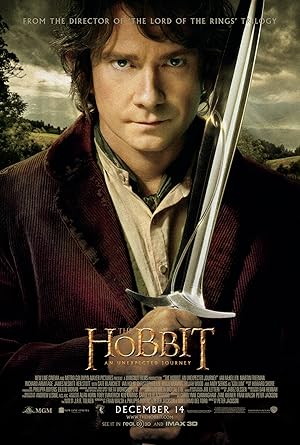
The Hobbit: An Unexpected Journey
Plot
Bilbo Baggins is swept into a quest to reclaim the lost Dwarf Kingdom of Erebor from the fearsome dragon Smaug. Approached out of the blue by the wizard Gandalf the Grey, Bilbo finds himself joining a company of thirteen dwarves led by the legendary warrior, Thorin Oakenshield. Their journey will take them into the Wild; through treacherous lands swarming with Goblins and Orcs, deadly Wargs and Giant Spiders, Shapeshifters and Sorcerers. Although their goal lies to the East and the wastelands of the Lonely Mountain first they must escape the goblin tunnels, where Bilbo meets the creature that will change his life forever ... Gollum. Here, alone with Gollum, on the shores of an underground lake, the unassuming Bilbo Baggins not only discovers depths of guile and courage that surprise even him, he also gains possession of Gollum's "precious" ring that holds unexpected and useful qualities ... A simple, gold ring that is tied to the fate of all Middle-earth in ways Bilbo cannot begin to know.
Get the Weekly Woke Watchlist
New and trending movies scored for woke bias, preachy messaging, and forced political themes — before you waste your evening.
No spam. One useful email per week.
Overall Series Review
Categorical Breakdown
Characters are judged based on their courage and moral fiber, demonstrating a universal meritocracy as Bilbo's inner strength is what makes him a hero over his timid appearance. The various races (Hobbits, Dwarves, Elves) are distinct, reflecting a classic mythic structure without any commentary on intersectional hierarchy, vilification of 'whiteness,' or forced insertion of contemporary diversity.
The narrative frames the Shire, the home culture, as a place of virtue and peace, which Bilbo must eventually leave but deeply desires to return to. The Dwarves' quest is entirely focused on reclaiming their ancestral home and heritage, a clear celebration of civilizational identity and tradition, not its deconstruction.
The main adventuring company is entirely male (Dwarves, Hobbit, Wizard). The primary female presence is Galadriel, who embodies the archetype of wise and formidable feminine power. Bilbo's heroism is rooted in domestic, 'feminine' qualities like kindness and guile, but this is used to re-define, not emasculate, the masculine hero archetype. There is no anti-natal or 'Girl Boss' messaging.
The movie contains no explicit LGBTQ+ themes, representation, or narratives that center alternative sexualities or gender ideology. The focus remains on the core quest and the bonds of male companionship and honor, with the traditional male-female pairing and nuclear family structure (the Shire) serving as the normative backdrop.
The entire story is built upon a transcendent moral law, where choices like Bilbo's act of pity towards Gollum are presented as decisive moments of moral virtue over power and greed. The concepts of 'Good' and 'Evil' are absolute, and the narrative promotes faith in the small acts of kindness, which functions as a form of objective morality.
Get the Weekly Woke Watchlist
New and trending movies scored for woke bias, preachy messaging, and forced political themes — before you waste your evening.
No spam. One useful email per week.