Breaking Bad
Season 3 Analysis
Season Overview
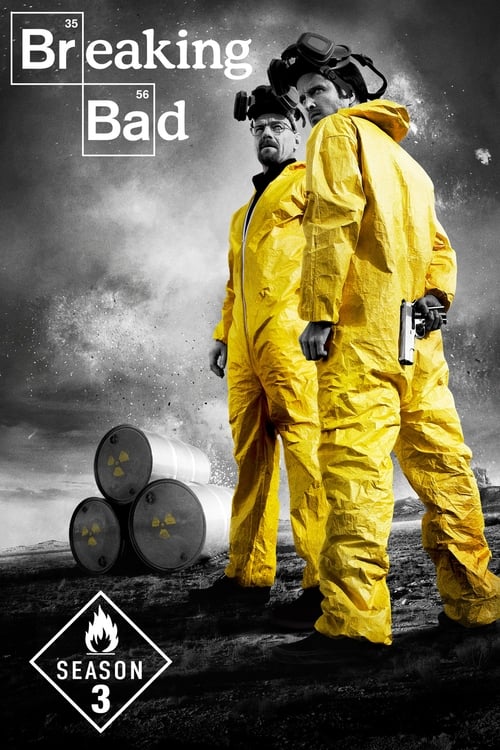
Walt continues to battle dueling identities: a desperate husband and father trying to provide for his family, and a newly appointed key player in the Albuquerque drug trade. As the danger around him escalates, Walt is now entrenched in the complex worlds of an angst-ridden family on the verge of dissolution, and the ruthless and unrelenting drug cartel.
Season Review
Categorical Breakdown
The narrative is primarily focused on the moral decline of a white male protagonist, Walter White, driven by his own ego, not a lecture on systemic oppression or white privilege. The central conflict is a personal moral decay judged by universal standards. While the major criminal antagonists (Gus Fring, the Cousins) are Latinx, perpetuating a regional stereotype of the drug trade, the main white characters, including Walt and Hank Schrader, are depicted as deeply flawed, abusive, and increasingly villainous, directly opposing the idea of a 'white savior' or vilification of 'whiteness.'
The series acts as a powerful critique of the modern American Dream and the toxic nature of the 'man provides' patriarchal ideal, portraying Walter White's attempts to provide for his family through criminality as the destruction of his family and himself. This deconstruction of the traditional American male's role and the institutions of family and career suggests a societal failure. However, the show does not frame the home culture as fundamentally corrupt/racist, but as a source of emasculation that leads Walter to *self-destruct*, rather than being an external 'Noble Savage' critique.
The female lead, Skyler White, is not a 'Girl Boss' with instant perfection or a career-first message. Instead, her character arc centers on her autonomy and agency to protect her children and separate from her criminal husband, which is a defensive, anti-crime, and pro-family action. The male characters, particularly Walter and Hank, are repeatedly exposed for their pride, ego, and destructive actions, which serves as an emasculation of the 'patriarchal' figure. The narrative criticizes a toxic form of traditional masculinity but does not promote anti-natalism; motherhood and the nuclear family are the stakes Walter continually puts at risk.
The season contains no explicit LGBTQ+ characters, relationships, or discussion of sexual ideology. The primary family drama is entirely centered on the destruction of the heterosexual nuclear family of the Whites and the Schraders due to Walter's criminal life. The focus remains on traditional male-female pairings and family units, even as those units are catastrophically disassembled by immoral choices.
The core of the series is a profound meditation on morality and consequence, where the protagonist's actions are consistently repaid with destruction and suffering. This adherence to a universal law of 'actions have consequences' is a form of poetic, objective morality. Walter's descent is a slow slide into 'evil' driven by pride, aligning with classic moral and theological themes of sin and judgment. There is no explicit attack or vilification of Christianity or organized religion; the spiritual vacuum is created by the characters' own choices, not the show's ideology.