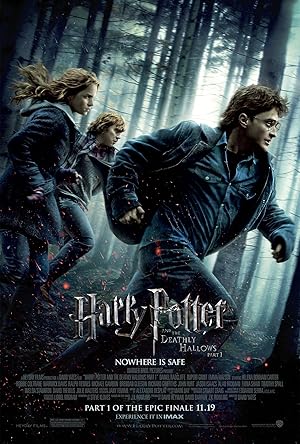
Harry Potter and the Deathly Hallows: Part 1
Plot
Voldemort's (Ralph Fiennes') power is growing stronger. He now has control over the Ministry of Magic and Hogwarts. Harry (Daniel Radcliffe), Ron (Rupert Grint), and Hermione (Emma Watson) decide to finish Dumbledore's (Sir Michael Gambon's) work and find the rest of the Horcruxes to defeat the Dark Lord. But little hope remains for the trio and the rest of the Wizarding World, so everything they do must go as planned.
Get the Weekly Woke Watchlist
New and trending movies scored for woke bias, preachy messaging, and forced political themes — before you waste your evening.
No spam. One useful email per week.
Overall Series Review
Categorical Breakdown
The plot's central conflict revolves around a 'pure-blood' supremacist ideology, a thinly veiled allegory for real-world systemic oppression and race-based bigotry. The hero's side champions a meritocracy where character is judged by deeds, opposing the fascist blood-status hierarchy. The casting remains true to the source material with no attempts at modern race-swapping or explicit 'vilification of whiteness.'
The narrative is driven by the urgent need to save the Wizarding World's fundamental institutions and values from a tyrannical takeover. The Weasley family is portrayed as an ideal of warmth, traditional family, and strength. The conflict focuses on correcting corruption within the government, not on deconstructing the civilization's heritage or traditions.
Hermione Granger is the intellectual powerhouse of the trio, whose knowledge and planning are indispensable. Strong female characters are positioned as capable warriors and leaders. The narrative celebrates motherhood through the protective power of Lily Potter’s sacrifice and Narcissa Malfoy’s climactic maternal lie. Male characters, though flawed, are not systematically emasculated or presented as incompetent.
The film does not contain any explicit centering of alternative sexualities or gender ideology. All on-screen romance and primary relationships follow the traditional male-female pairing structure. There is no lecturing or deconstruction of the nuclear family unit.
The entire story is a moral struggle between selfless love and sacrificial death versus fear of death and selfish evil, embodying universal moral and spiritual truths. The narrative strongly embraces an objective moral law, and the themes align with religious archetypes of a hero's death and resurrection, positioning faith and love as a transcendent power against darkness.
Get the Weekly Woke Watchlist
New and trending movies scored for woke bias, preachy messaging, and forced political themes — before you waste your evening.
No spam. One useful email per week.