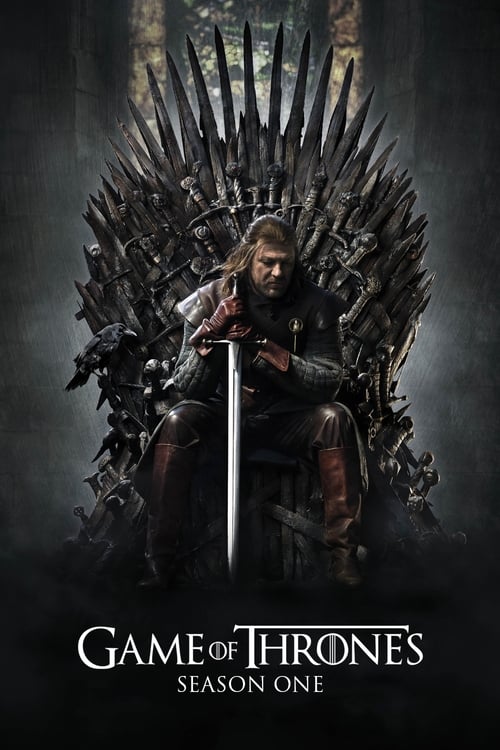
Game of Thrones
Season 1 Analysis
Season Overview
Trouble is brewing in the Seven Kingdoms of Westeros. For the driven inhabitants of this visionary world, control of Westeros' Iron Throne holds the lure of great power. But in a land where the seasons can last a lifetime, winter is coming...and beyond the Great Wall that protects them, an ancient evil has returned. In Season One, the story centers on three primary areas: the Stark and the Lannister families, whose designs on controlling the throne threaten a tenuous peace; the dragon princess Daenerys, heir to the former dynasty, who waits just over the Narrow Sea with her malevolent brother Viserys; and the Great Wall--a massive barrier of ice where a forgotten danger is stirring.
Season Review
Categorical Breakdown
The vast majority of characters and the core power struggle focus on white, aristocratic families, which gives the initial season a more traditional, ethnically-focused medieval aesthetic. Diversity is not forced into the primary Western-inspired setting. However, the one major non-Western group, the Dothraki, are introduced in a way that eventually highlights their brutal yet potent 'natural' culture as a source of strength, contrasting the corrupt 'whiteness' of Westerosi courts.
The entire season acts as an indictment of the established Westerosi civilization. The institutions of the Monarchy and the King's Court are depicted as being fundamentally decadent, corrupt, and founded on lies and incest. The one truly moral and honorable family patriarch is betrayed and destroyed by the system he tries to protect, clearly framing the 'home culture' as irredeemably flawed and inviting its deconstruction.
The setting is intensely patriarchal, featuring explicit misogyny and sexual violence, which is counter to the 'Girl Boss' trope. However, the narrative trajectory of key female characters, such as the exiled princess and the youngest daughter, involves actively rejecting or subverting traditional feminine roles to acquire power and survival skills. The most powerful woman in the capital is a calculating, competent schemer who operates entirely outside the constraints of domesticity.
Alternative sexualities are a visible part of the world and are directly tied to political maneuvering. A major power player is involved in a prominent homosexual relationship with a key knight. This is presented matter-of-factly and sensationally, but without the explicit political lecturing found in a higher score. The presence of same-sex sexual encounters for the protagonist's sexual education also introduces queer dynamics into a major character's development.
The overarching philosophy of the world is that of ruthless realpolitik and moral relativism. Characters who attempt to follow a strict moral code, such as honor or duty (the transcendent morality), are swiftly and brutally killed, proving that virtue is an impediment to power. The various religions in Westeros are largely presented as political tools or minor cultural aesthetics, and the action is driven entirely by human ambition and power dynamics, asserting that no objective, higher moral law exists.