Game of Thrones
Season 6 Analysis
Season Overview
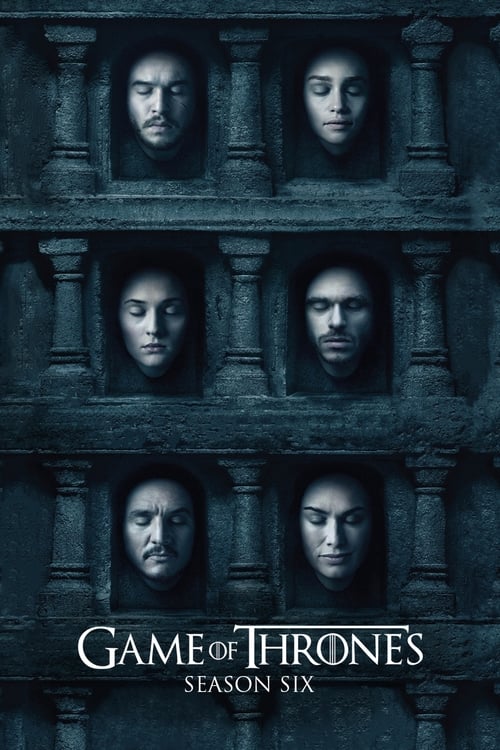
Following the shocking developments at the conclusion of season five, survivors from all parts of Westeros and Essos regroup to press forward, inexorably, towards their uncertain individual fates. Familiar faces will forge new alliances to bolster their strategic chances at survival, while new characters will emerge to challenge the balance of power in the east, west, north and south.
Season Review
Categorical Breakdown
The narrative places a major focus on the oppressed rising up against the established nobility, which is a form of intersectional hierarchy, though primarily power and gender-based rather than racial. Female characters assume power by destroying or replacing white male leaders across the continent, suggesting that their authority is justified not by traditional merit but by their status as survivors of systemic abuse and victims of the patriarchy. The primary opposition to the heroes are male characters defined by their toxic privilege and cruelty, such as Ramsay Bolton, who is ultimately defeated and killed by a female character.
Westeros, the primary setting and analogue for Western civilization, is consistently portrayed as fundamentally corrupt, chaotic, and beyond repair under its traditional institutions. Many major white male leaders are deposed or assassinated, framed as necessary removals of a toxic, bankrupt system. The narrative positions the incoming forces, particularly the foreign army led by Daenerys Targaryen and the cultural changes from marginalized regions like Dorne, as the only viable path for justice and a more equitable society. Gratitude for the established culture is entirely absent.
This season is defined by the ascendancy of female characters, who secure power across all major regions. Powerful male figures are eliminated or emasculated, leaving a vacuum filled by female 'Girl Boss' figures like Cersei Lannister, Sansa Stark, and Daenerys Targaryen. The narrative validates a feminism where women's strength is shown through their ability to wield violence and political ruthlessness, often in direct counter-point to the perceived weakness or moral failure of the remaining male characters. Motherhood is not a celebrated theme, as the most powerful female characters are either explicitly anti-natalist or have lost their children and are driven by cold, violent ambition.
Alternative sexualities are centered through the political alliance and relationship of Yara Greyjoy and Daenerys Targaryen, positioning a queer pairing as a significant force against the traditional Westerosi power structure. The organized, conservative Faith of the Seven is shown to persecute and condemn homosexuality, which the narrative implicitly validates by framing the Faith Militant as a fundamentalist, villainous group that is spectacularly destroyed in the season finale. Sexuality is made political, validating the alternative and villainizing the normative structure.
The main religion of the continent, the Faith of the Seven (which serves as a clear historical analogue to traditional Western religion), is the core villain for the King's Landing storyline. This fundamentalist religious movement is shown to be cruel, hypocritical, and oppressive, controlling the King and terrorizing the secular nobility. The climax involves a powerful female character, Cersei Lannister, completely destroying the entire religious institution and its followers in an act of mass murder, eliminating the primary obstacle to her secular rule. Traditional religion is explicitly demonstrated as the root of societal tyranny that must be annihilated to achieve liberation.