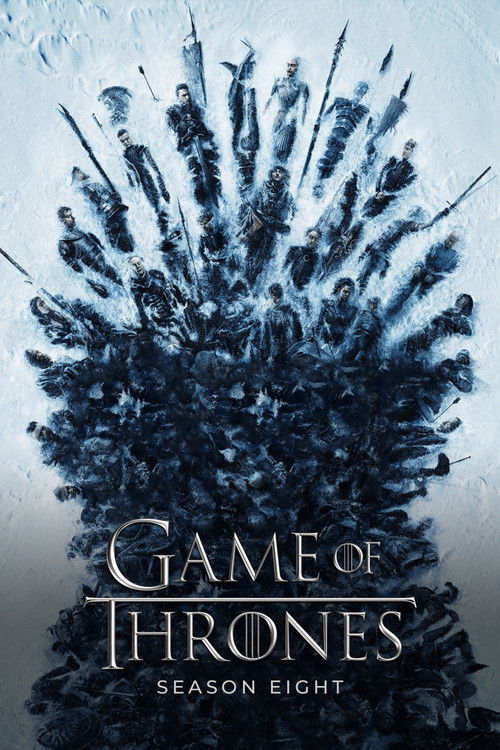
Game of Thrones
Season 8 Analysis
Season Overview
The Great War has come, the Wall has fallen and the Night King's army of the dead marches towards Westeros. The end is here, but who will take the Iron Throne?
Season Review
Categorical Breakdown
The narrative's major political outcome places a non-combatant, non-traditional white male character on the new throne and a council of mostly white males into power, which was criticized by progressive commentators as a reinforcement of 'white male privilege'. This ending actively subverts the expectation of a non-white or female leader ascending to the Iron Throne, demonstrating a priority on character function (the King's unique perspective) over intersectional hierarchy. The primary casting remains historically consistent with the fictional world's setting, featuring no race-swapping for major Westerosi houses.
The climactic battle against the otherworldly enemy is quickly resolved, making human political corruption the ultimate and more dangerous threat. The main capital city of Westeros is annihilated by a protagonist’s army, which frames the seat of 'civilization' as a rotten structure deserving of destruction. The ultimate political solution is a return to an established, Western-analogue feudal system, suggesting that the foundational institutions (monarchy, kingdom structure) are necessary for order, which slightly mitigates the score.
Powerful female characters achieve the greatest success, with one assuming the Queen in the North title and another being the celebrated hero who defeats the ultimate evil. The female protagonist who sought to 'break the wheel' and install radical change is quickly corrupted by power and dies, portraying political ambition in a woman as leading to madness and destruction—a common anti-feminist trope according to some analysis. The high score is a consequence of the 'Mary Sue' moment where the female assassin defeats the central villain without a clear prophetic setup, and the final crowning of an independent Queen.
The season contains no overt lecturing on sexual ideology or gender theory. The narrative focuses almost exclusively on traditional male-female pairings and political conflicts, with sexual identity and alternative lifestyles remaining in the background, as they have throughout the series. The emphasis is on power and lineage, not on centering non-traditional sexuality or deconstructing the nuclear family as a political act.
The most significant spiritual narrative, the 'Prince that was Promised' prophecy, is rendered functionally meaningless for the main prophesied character, and the entire White Walker conflict is abruptly solved without a deep spiritual confrontation. This downplays the importance of faith and prophecy in the world's outcome. However, the show avoids direct vilification of 'Christian-analogue' faith systems in favor of showing all religions as tools of power or superstition, keeping the score from the extreme end.