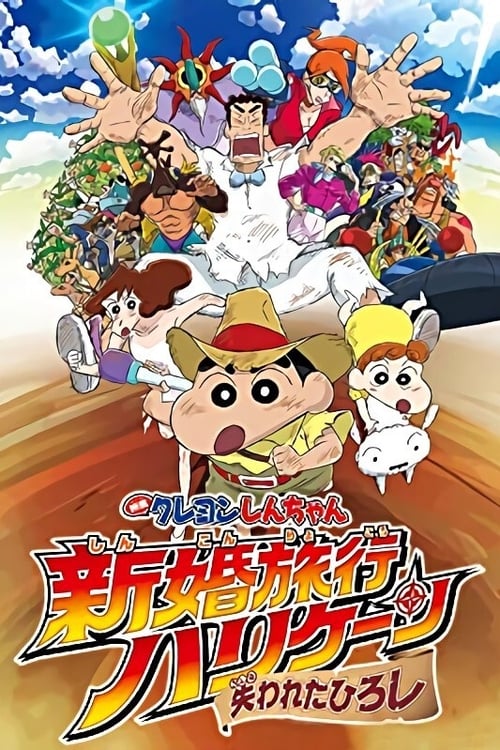
Crayon Shin-chan: Honeymoon Hurricane ~The Lost Hiroshi~
Plot
Hiroshi and Misae have never been to a honeymoon trip to a foreign country. One day, Misae discovered an inexpensive and family-friendly holiday package to Australia and the Nohara family decided to make it their first honeymoon vacation. Hiroshi gets kidnapped upon arrival to Australia, leaving Shinnosuke, Misae and others on a dangerous journey. It turns out that Hiroshi is the key to a secret treasure. The remaining members of the Nohara Family must rescue Hiroshi, while a mysterious masked man and treasure hunters from all over the world are after him. The struggle is among three different groups in this action-filled treasure hunting adventure.
Get the Weekly Woke Watchlist
New and trending movies scored for woke bias, preachy messaging, and forced political themes — before you waste your evening.
No spam. One useful email per week.
Overall Series Review
Categorical Breakdown
The antagonists are a diverse group of treasure hunters, but their motivation is purely based on material greed for a secret treasure, not race or intersectional politics. The plot does not rely on race or immutable characteristics for conflict, and there is no lecturing on privilege or systemic oppression.
The movie is a direct celebration of the family unit, marriage, and the sacrifices of ancestors (by honoring the parents' marriage with a honeymoon). The central institution (the family) is depicted as the protective shield against chaos and outside threats. No element frames the home culture as corrupt or demonizes ancestors.
The score reflects a slight tilt due to the central plot device: Misae, the mother, must actively rescue Hiroshi, the father, who is the 'lost' object. This reverses the damsel trope, showcasing Misae as a highly capable and action-oriented woman. However, this is largely a comedic reversal and is fundamentally pro-family, as Misae's motivation is to save her husband and preserve her marriage, celebrating rather than rejecting motherhood or the family structure.
The narrative focuses exclusively on the traditional nuclear family (husband, wife, two children) and the celebration of their male-female pairing through a honeymoon. The plot contains no references to sexual ideology, centering of alternative sexualities, or lecturing on gender theory.
The movie is a secular action-adventure focused on a material treasure hunt and family rescue. There is no presence of anti-theistic messaging, hostility toward religion, or a conflict based on moral relativism. The simple moral framework acknowledges objective truth in the difference between family love and the villains' greed.
Get the Weekly Woke Watchlist
New and trending movies scored for woke bias, preachy messaging, and forced political themes — before you waste your evening.
No spam. One useful email per week.