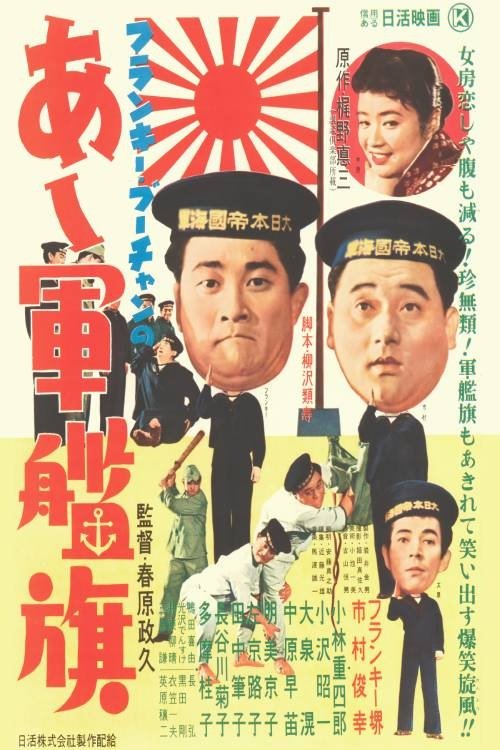
Frankie Bûchan no Aa gunkanki
Plot
The day has come for recruits to enlist in the Japanese Marine Corps. The recruits, who have left the free world to enter this strict military life, look nervous. Monma Santaro (Frankie Sakai), who grew up in Edo and is small but smart, and Mamada Gosaku (Toshiyuki Ichimura), who was born in Tohoku and has a strong 'zuzu' dialect, have also been called up.
Get the Weekly Woke Watchlist
New and trending movies scored for woke bias, preachy messaging, and forced political themes — before you waste your evening.
No spam. One useful email per week.
Overall Series Review
Categorical Breakdown
Characters are defined by personal merit, such as Santaro being 'smart' and 'clever,' and regional/cultural differences (Edo vs. Tohoku dialect), not racial or intersectional hierarchy. The central conflict is based on rank and personal bumbling within the military structure, not systemic oppression or forced diversity.
The setting is the Japanese Marine Corps in the post-war era. As a comedy, it likely critiques the absurdities and strict discipline of the military system, which is an internal critique of an institution. This critique of institutional rigidity does not extend to framing the nation or its core values as fundamentally corrupt.
The narrative is centered on the lives of two male recruits in a strict, all-male military environment. The few female characters mentioned are a wife and cafe waitresses, placing them in traditional or service roles. There is no presence of 'Girl Boss' tropes, emasculation of male leads, or anti-natalist messaging.
The film is a 1957 military comedy with a focus on men's camaraderie and training. There is no evidence of centering alternative sexualities, deconstructing the nuclear family, or lecturing on gender theory. The narrative structure is entirely normative for the period and genre.
The plot is a secular military comedy focused on discipline, rank, and personal relationships. Religion and moral philosophy are not a subject of the narrative. Morality is likely defined by the clear rules and hierarchy of the military, which acknowledges an objective standard of conduct, however strict or absurd.
Get the Weekly Woke Watchlist
New and trending movies scored for woke bias, preachy messaging, and forced political themes — before you waste your evening.
No spam. One useful email per week.