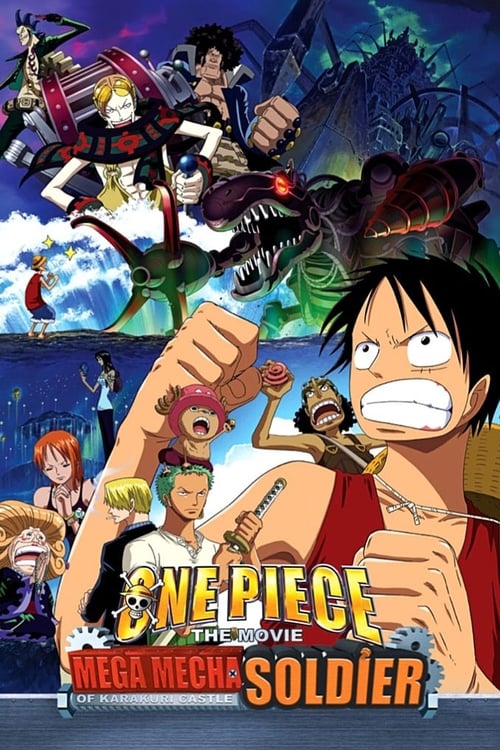
One Piece: Giant Mecha Soldier of Karakuri Castle
Plot
The Straw Hats visits an island, known as Mecha Island, where a fisherman sings an old folk song about a Golden Crown. Searching for that mysterious treasure, they find a hidden entrance into the island. The island's leader, Ratchet, impressed with the find and in search of the Golden Crown himself, invites the crew to join him in his search and the crew along with Ratchet and his henchmen enter the cave. As it turns out, the islands true form, is that of a giant turtle. Ratchet, who had known this all along, uses his mechanical castle to take control of the turtle, in order to use it, to take over the world. Now the Straw Hats have to stop not only Ratchet, but also the helpless turtle, from crashing into a nearby island.
Get the Weekly Woke Watchlist
New and trending movies scored for woke bias, preachy messaging, and forced political themes — before you waste your evening.
No spam. One useful email per week.
Overall Series Review
Categorical Breakdown
The plot centers on a treasure hunt and stopping a self-proclaimed genius from world domination. Characters are judged solely on their merit, power, and moral alignment (pirates vs. villainous scientist). Race, immutable characteristics, and intersectional themes are entirely absent from the core conflict and character motivation.
The central conflict is a high-stakes adventure against a mad individual attempting to misuse technology for conquest. The narrative displays no hostility toward any specific civilization, home culture, or ancestors. The villain's motive is personal megalomania, not a critique of societal structures. The story celebrates the heroes’ freedom and the pursuit of adventure.
Female characters like Nami and Robin are integral to the crew's success, demonstrating high levels of skill and intellect. Nami takes a strong, often aggressive and comedic, leadership role over the ‘boys.’ However, the movie features significant visual fan service, including exaggerated female physical attributes and revealing outfits for Nami and Robin, preventing a perfect 1/10 score. The theme does not preach anti-natalism, as the loss of the Japanese voice actor for a major character is noted as being due to maternity leave.
The movie contains no centering of alternative sexualities, deconstruction of the nuclear family, or discussion of gender ideology. The focus remains strictly on the adventure, combat, and traditional pirate-crew dynamic. All characters operate within a normative structure without any sexual or gender lecturing.
The conflict is purely secular: a mad scientist attempts to take control of the world with mecha. Religion, spirituality, and objective truth are not thematic elements of the plot. The narrative is driven by classic Shonen morality based on friendship, courage, and a clear distinction between heroic and villainous actions.
Get the Weekly Woke Watchlist
New and trending movies scored for woke bias, preachy messaging, and forced political themes — before you waste your evening.
No spam. One useful email per week.