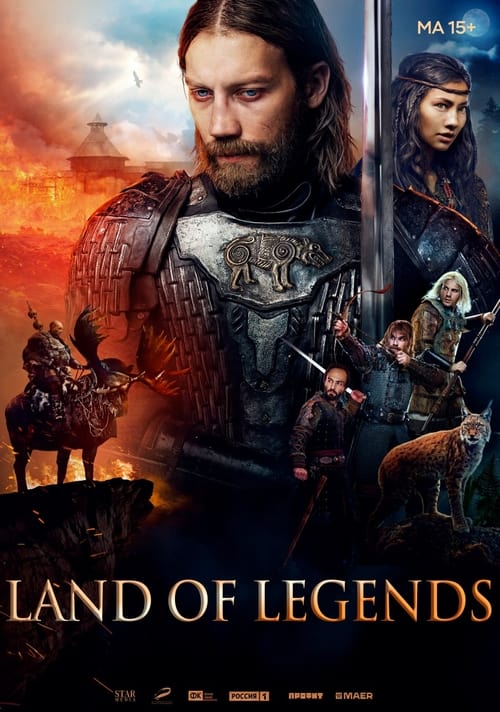
Land of Legends
Plot
The history of the confrontation between two worlds: the Grand Duchy of Moscow and the Ural Parma, the ancient Perm lands inhabited by pagans. Here heroes and ghosts, princes and shamans, Voguls and Muscovites will clash. At the center of the conflict of civilizations is the fate of the Russian prince Mikhail, who fell in love with the young Tiche, a witch-lamia capable of taking on the form of a lynx. Passion for the pagan and fidelity to forbidden love, a campaign against the Voguls, bloody battles and a short peace, the battle between Muscovy and Parma, the hero will face trials in which it is not so terrible to part with life as to commit treason.
Get the Weekly Woke Watchlist
New and trending movies scored for woke bias, preachy messaging, and forced political themes — before you waste your evening.
No spam. One useful email per week.
Overall Series Review
Categorical Breakdown
The central conflict pits the dominant ethnic-cultural identity (Muscovite/Russian) against the marginalized identity (Ural Parma/Vogul pagans). The protagonist's defining trial is whether to commit treason against his own people and their expanding empire to protect his ethnic 'other' wife and her local allies. The narrative structure makes the identity of the conquering force the source of oppression and the identity of the indigenous people the source of a forbidden, but morally compelling, loyalty.
The institutions of the protagonist's home culture, the Grand Duchy of Moscow, are depicted as a force of aggressive unification and imperial ambition, seeking to 'overpower' disparate peoples. The story romanticizes the 'other' culture of Ural Parma, which is aligned with nature, ancient spirits, and authentic, local heritage. The hero's moral arc requires him to reject the violent progress of his own civilization for the more spiritual and traditional path represented by the pagan land and its people.
The main female character, Tiche, is a powerful witch-lamia capable of shapeshifting and is the physical incarnation of the paramount pagan symbol, the Golden Woman. Her identity is not that of a simple love interest but a central, supernatural, and political/spiritual force that controls the fate of Parma. This makes her an immensely powerful, active figure who dictates the male hero's ultimate life choice, positioning her in a dominant spiritual and symbolic role.
The narrative focuses exclusively on the historical and religious conflict between two civilizations and the forbidden heterosexual romance between the Prince and the pagan witch. There is no indication of themes related to centering alternative sexualities, deconstructing the nuclear family, or promoting modern gender ideology.
The conflict is a direct confrontation between the institutional power of the expanding Christian state (Moscow) and the ancient, nature-based spirituality of the pagans (Parma). The Christian side is explicitly framed as the aggressive, conquering force that the hero must ultimately betray to maintain fidelity to his love and his local allies. Faith and virtue are found in the forbidden, pagan, and magical relationship, while the traditional, official religion of the Grand Prince is associated with imperial power and aggression.
Get the Weekly Woke Watchlist
New and trending movies scored for woke bias, preachy messaging, and forced political themes — before you waste your evening.
No spam. One useful email per week.