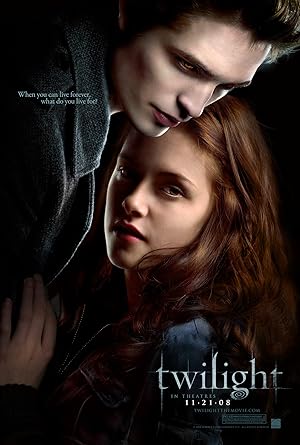
Twilight
Plot
Bella Swan has always been a little bit different. Never one to run with the crowd, Bella never cared about fitting in with the trendy girls at her Phoenix, Arizona high school. When her mother remarries and Bella chooses to live with her father in the rainy little town of Forks, Washington, she doesn't expect much of anything to change. But things do change when she meets the mysterious and dazzlingly beautiful Edward Cullen. For Edward is nothing like any boy she's ever met. He's nothing like anyone she's ever met, period. He's intelligent and witty, and he seems to see straight into her soul. In no time at all, they are swept up in a passionate and decidedly unorthodox romance - unorthodox because Edward really isn't like the other boys. He can run faster than a mountain lion. He can stop a moving car with his bare hands. Oh, and he hasn't aged since 1918. Like all vampires, he's immortal. That's right - vampire. But he doesn't have fangs - that's just in the movies. And he doesn't drink human blood, though Edward and his family are unique among vampires in that lifestyle choice. To Edward, Bella is that thing he has waited 90 years for - a soul mate. But the closer they get, the more Edward must struggle to resist the primal pull of her scent, which could send him into an uncontrollable frenzy. Somehow or other, they will have to manage their unmanageable love. But when unexpected visitors come to town and realize that there is a human among them Edward must fight to save Bella? A modern, visual, and visceral Romeo and Juliet story of the ultimate forbidden love affair - between vampire and mortal.
Get the Weekly Woke Watchlist
New and trending movies scored for woke bias, preachy messaging, and forced political themes — before you waste your evening.
No spam. One useful email per week.
Overall Series Review
Categorical Breakdown
The movie's world is overwhelmingly white-centric, focusing on the Swan and Cullen families. The film does not contain explicit lectures on privilege or systemic oppression. The Native American Quileute tribe is introduced via Jacob Black, but their primary role in this first film is to represent a distinct, isolated community, setting up a later narrative conflict. The depiction does not rely on intersectional hierarchy but rather positions the white main characters and the Quileutes as separate groups without a systemic power dynamic lecture.
The film does not frame Western culture as fundamentally corrupt. Forks, Washington, is simply a rainy, small-town backdrop, not a symbol of a decaying society. The Cullen family, though centuries old, represents a civilized, self-disciplined, and internally structured family unit that adheres to a code of conduct protecting human life, which is the antithesis of civilizational self-hatred. No ancestor or heritage is demonized; rather, the good characters strive to overcome their monstrous nature through adherence to a self-imposed moral code.
The female lead, Bella Swan, is explicitly portrayed as ordinary, clumsy, and highly dependent on Edward. She is not a "Girl Boss" or a "Mary Sue" who is instantly perfect; she often requires rescue. Edward is depicted as an idealized, hyper-competent, and protective male, not a bumbling idiot. The central dynamic is one of submission and protection, which is criticized by some feminists as patriarchal. The narrative strongly promotes sexual abstinence before marriage, contrasting sharply with the anti-natal, sexual liberation messages common in high-score woke media.
The core of the narrative is an intense, singular, and highly romanticized pairing between a biological male and a biological female. The film is fundamentally heteronormative, with the Cullen family serving as an idealized, traditional nuclear family unit. There is no presence of gender ideology, centering of alternative sexualities, or deconstruction of the nuclear family structure. Sexuality is private and controlled by the desire for marital commitment.
The narrative is rich with themes that parallel traditional religious morality. The 'good' vampires, the Cullens, follow a 'vegetarian' lifestyle (abstinence from human blood/murder) and practice celibacy, reflecting strong Christian moral codes. Edward's struggle to control his urges is portrayed as an ultimate test of moral will and transcendent value, not subjective power dynamics. The character of Carlisle Cullen believes in the soul and an afterlife. The movie frames morality as an objective, higher law that characters choose to follow or reject.
Get the Weekly Woke Watchlist
New and trending movies scored for woke bias, preachy messaging, and forced political themes — before you waste your evening.
No spam. One useful email per week.