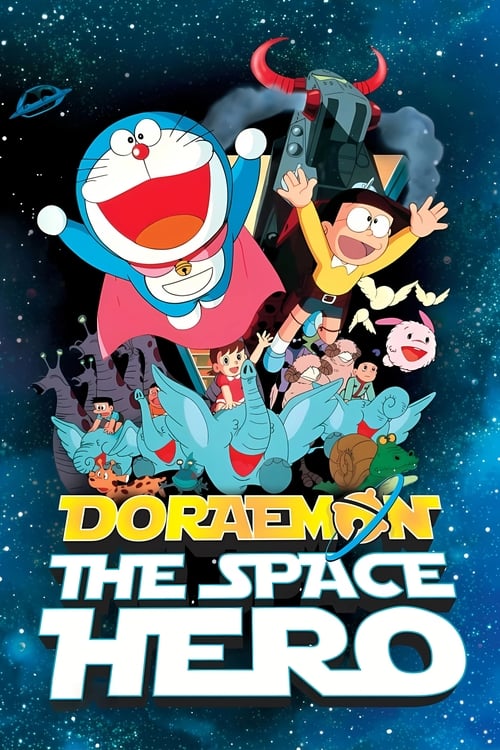
Doraemon: The Record of Nobita, Spaceblazer
Plot
Seven years ago, Lopplc and Morina were playing at a park. Suddenly they felt an earthquake on the Koya Koya Planet. The quake was so massive that the planet was destroyed. Everyone had to escape using a giant ship. A sudden bolt of lightning damaged the ship, causing a power failure. The Professor (who was Morina's father) wanted to fix the spaceship, but another lightning strike took him to another dimension.
Get the Weekly Woke Watchlist
New and trending movies scored for woke bias, preachy messaging, and forced political themes — before you waste your evening.
No spam. One useful email per week.
Overall Series Review
Categorical Breakdown
Characters are judged entirely by their actions; the heroes are a diverse group of human children and aliens, and the villains are a space mining corporation. The narrative is a simple good-versus-evil story, universally applied, that does not use race or intersectional hierarchy to assign virtue or vice. Nobita's ability to become a hero is based on the low-gravity physics of the alien planet, a plot mechanic, not on an immutable characteristic or a lecture on privilege. The casting is colorblind/alien-inclusive without forced diversity or vilification of any specific demographic.
The film’s central moral message is a ‘Green Aesop,’ where the pure, beautiful alien planet is threatened by a rapacious, resource-mining corporation. This critique is directed at universal corporate greed and industrial destruction, which is not framed as an explicit denouncement of the 'Western home culture' or Japanese society. The Earth children from Japan are the saviors of the alien culture, preventing the narrative from collapsing into civilizational self-hatred. A core Western-adjacent value, the defense of the defenseless and natural liberty, is championed.
The female protagonists, Shizuka and Morina, are capable and brave. Shizuka takes a key role in calling the other friends to action to help their alien friends, and Morina is a crucial participant in the final confrontation against the villain. However, the core narrative drive and central 'superpower' arc belong to the male character Nobita. The film does not feature any 'Mary Sue' tropes, male emasculation, or anti-natalist messaging. The long-established relationship between Nobita and Shizuka reinforces traditional future family structure.
The movie is a sci-fi adventure focusing on children and lacks any sexual themes. There is no presence of alternative sexualities, gender identity concepts, or deconstruction of the nuclear family. The film operates within a normative structure where the traditional family unit is the unstated standard.
The moral conflict is entirely secular and material, centered on corporate greed versus environmental protection and friendship. Morality is objective, clearly defining the mining corporation as evil and the protectors of the planet as good. There is no presence of religious themes, hostility toward faith, or promotion of moral relativism.
Get the Weekly Woke Watchlist
New and trending movies scored for woke bias, preachy messaging, and forced political themes — before you waste your evening.
No spam. One useful email per week.