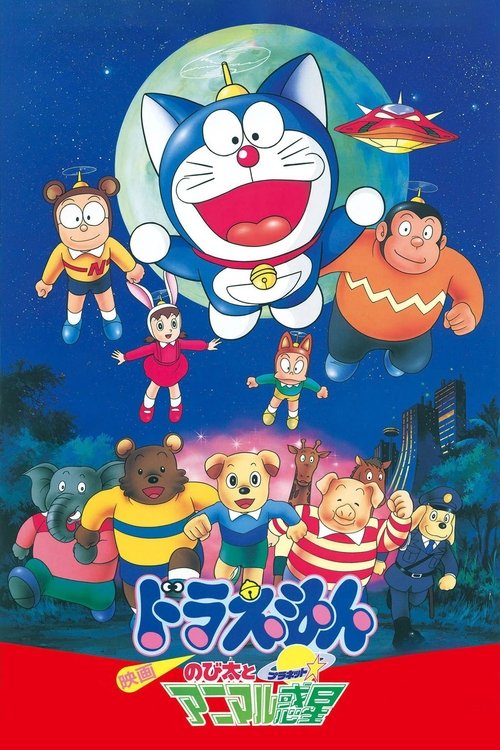
Doraemon: Nobita and the Animal Planet
Plot
A mysterious pink fog takes Nobita, Doraemon, Shizuka, Suneo, and Gian to a planet populated by animals. Legend says that the ancestors of this population used to live on the moon, but were transported out of there to escape from the voracious creatures that lived there too.
Get the Weekly Woke Watchlist
New and trending movies scored for woke bias, preachy messaging, and forced political themes — before you waste your evening.
No spam. One useful email per week.
Overall Series Review
Categorical Breakdown
The narrative conflict is centered on the morality of two different civilizations (animal-people vs. Nimuge humans) and their environmental ethics, not on immutable characteristics within a human intersectional hierarchy. Character merit is judged by their moral choices, such as Nobita's determination or the Nimuge's greed, not by race or gender. The casting and character dynamics follow the established, culturally specific norms of the original 1990 series.
The plot is a textbook example of this theme. The 'Nimuge' are revealed to be humans who destroyed their original planet through 'excessive development,' reducing it to a polluted wasteland. They are portrayed as morally and culturally inferior to the animal-people, who live in a 'beautiful utopia' rooted in pacifism and environmental protection. Human civilization and its ancestors are framed as fundamentally corrupt and destructive, while an external culture (the animal-people) is depicted as spiritually and morally superior.
The gender dynamics are traditional and complementary, aligning with the core series. Shizuka is an active participant in the adventure, using an animal-trait-enhancing gadget to contribute to the mission. However, the main heroic action, such as the solo rescue of the hostage Romi, is carried out by the male protagonist, Nobita. The female lead is not a 'Mary Sue' and male characters are not universally emasculated or incompetent; Nobita demonstrates unexpected courage, and Gian provides strength.
The movie maintains a normative structure. The focus is entirely on a science-fiction environmental adventure plot. There is no introduction, centering, or lecturing on alternative sexualities, deconstructing the nuclear family, or gender ideology. The traditional male-female pairing and nuclear family structure are the unstated standard.
Religion is portrayed positively. The animal-people's deep religious beliefs and creation myth are directly credited with establishing their pacifist, environmentally-protective society. This myth prohibits the development of weapons and spacecraft and has a major impact on the planet's thorough environmental conservation. Faith and a higher moral law are shown as a source of strength and societal virtue, which is the antithesis of anti-theism.
Get the Weekly Woke Watchlist
New and trending movies scored for woke bias, preachy messaging, and forced political themes — before you waste your evening.
No spam. One useful email per week.