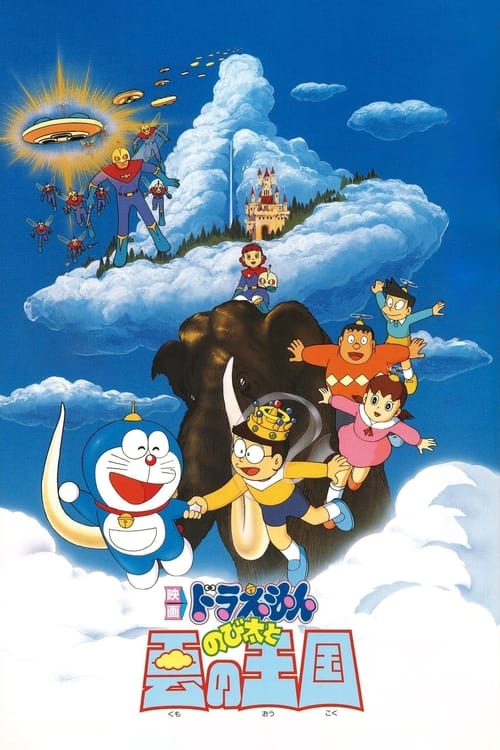
Doraemon: Nobita and the Kingdom of Clouds
Plot
Nobita begins to wonder if Heaven exists in the clouds while studying about them at school. At first he is ridiculed but finally Doraemon decides to help him explore the idea.
Get the Weekly Woke Watchlist
New and trending movies scored for woke bias, preachy messaging, and forced political themes — before you waste your evening.
No spam. One useful email per week.
Overall Series Review
Categorical Breakdown
The narrative conflict does not rely on race or intersectional hierarchy. The central tension is between the 'Sky People' and 'Surface People,' a division based on environmental stewardship and technological advancement, not immutable demographic characteristics. The characters are judged by their actions, specifically their role in either destroying or protecting nature. The human antagonists are four poachers, whose villainy is defined entirely by their criminal acts of slaughtering endangered animals.
The central premise frames Earth's civilization as fundamentally corrupt, leading a superior, evolved culture (the Sky People) to plan a total, apocalyptic cleansing (Project Noah/Great Flood). This aligns heavily with the deconstruction and demonization of the home culture's impact. However, the ultimate resolution prevents the highest score, as the plan is cancelled by an argument that defends humanity’s capacity for kindness and environmental protection, providing a pathway for surface civilization to change rather than being wholly condemned.
Gender roles follow the normative structure of a classic 1990s children's anime. Female characters like Shizuka Minamoto are often portrayed as the most sensible members of the group, serving as the 'Voice of Reason' in critical moments like the trial, providing a contrast to the boys' typical bumbling nature. The film contains no evidence of anti-natalist messaging or radical gender theory, maintaining a complementary dynamic without resorting to 'Girl Boss' tropes.
There is no presence of alternative sexual ideology, queer theory, or discussion of gender identity in the narrative. The depiction of society and the central family structures maintains a traditional, normative standard common to family-friendly media of the period.
The film utilizes and repurposes spiritual and religious allegory, specifically the concept of Heaven and the Biblical Great Flood ('Project Noah'), for a science-fantasy environmental morality tale. The Sky People act as a judging force, but the conflict is resolved based on an appeal to objective moral truth—human kindness and stewardship—rather than a vilification of traditional faith. Faith is used as a setting and framework to deliver a moral lesson, not a source of evil or bigotry.
Get the Weekly Woke Watchlist
New and trending movies scored for woke bias, preachy messaging, and forced political themes — before you waste your evening.
No spam. One useful email per week.