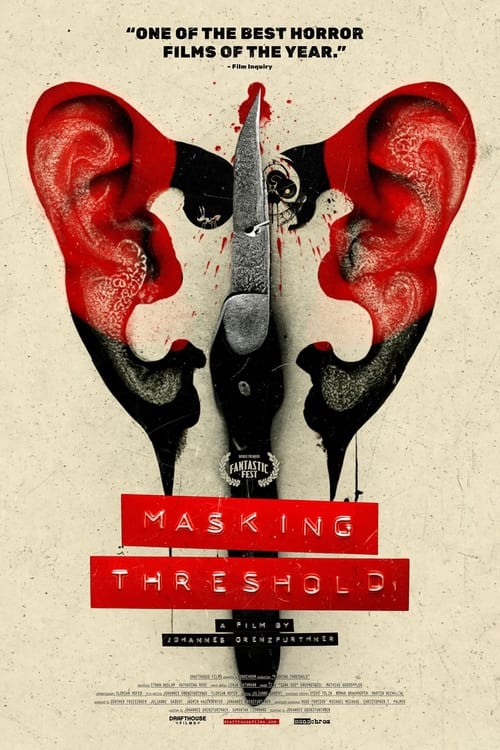
Masking Threshold
Plot
Conducting a series of experiments in his makeshift home-lab, a skeptic IT worker tries to cure his harrowing hearing impairment. But where will his research lead him? "Masking Threshold" combines a chamber play, a scientific procedural, an unpacking video, and a DIY YouTube channel while suggesting endless vistas of existential pain and decay. Glimpse the world of the nameless protagonist in this eldritch tale, which is by no means for the faint of heart.
Get the Weekly Woke Watchlist
New and trending movies scored for woke bias, preachy messaging, and forced political themes — before you waste your evening.
No spam. One useful email per week.
Overall Series Review
Categorical Breakdown
The protagonist is explicitly identified by the director as a "queer" male, and the director cites the film as exploring the societal pressure and trauma he experienced due to his identity. The plot centers on a white male who spirals into isolation, obsessive paranoia, and monstrous evil, which aligns with the "White males depicted as incompetent/evil" metric, although his descent is tied to his psychological state and chronic illness rather than an overt political lecture. The film uses the character's status as an oppressed identity (queer) as a stated context for his trauma and eventual malevolence.
The film does not contain direct, explicit demonization of Western civilization, ancestors, or institutions in its narrative. The single-room setting and focus on internal madness do not provide scope for extensive civilizational critique. The isolation and paranoia themes are presented by the director as allegories for contemporary conspiratorial and reactionary subcultures which can include anti-establishment sentiments, but this is a commentary on culture, not a wholesale indictment of the West. The horror is of the Lovecraftian variety, emphasizing cosmic insignificance rather than a corrupt societal structure.
The film centers exclusively on the male protagonist and his internal world, leaving little room for analysis of gender dynamics in the context of the "Girl Boss" or anti-natalism tropes. There are no major female characters to portray as "Mary Sues" or "Girl Bosses." The main character is a toxic and destructive male. He mentions breaking off a relationship but the former partner is not a central figure. The film's core theme is a male descent into insanity.
The protagonist's queer identity is introduced as a central aspect of his character background and personal trauma. The director explicitly frames the film as a way to understand the "societal pressure" and "trauma" experienced by the "queer" protagonist. This places a specific sexual identity and its related perceived oppression at the foundation of the character's motivation and storyline. The centering of a non-normative sexual identity as a basis for trauma and the narrative arc aligns with the highest score criteria for sexual ideology driving the story.
The protagonist is explicitly an anti-theist and an unyielding scientific rationalist who rejects any supernatural, spiritual, or faith-based alternatives for his condition. He "abhors religion" and sneers at his mother's homeopathic ideas, demanding a scientific, materialist solution. The entire narrative is a descent into Lovecraftian horror, which is a literary tradition rooted in cosmic nihilism and the insignificance of man and his god-concepts, effectively endorsing a spiritual vacuum where higher moral law is absent. The director is openly an atheist, aligning with the worldview presented in the film.
Get the Weekly Woke Watchlist
New and trending movies scored for woke bias, preachy messaging, and forced political themes — before you waste your evening.
No spam. One useful email per week.