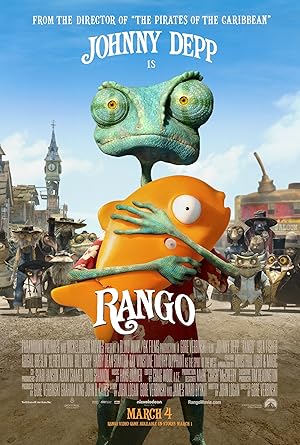
Rango
Plot
Rango is a pet chameleon always on the lookout for action and adventure, except the fake kind, where he directs it and acts in it. After a car accident, he winds up in an old western town called Dirt. What this town needs the most is water, but they also need a hero and a sheriff. The thirsty Rango instantly takes on the role of both and selfishly agrees to take on the case of their missing water.
Get the Weekly Woke Watchlist
New and trending movies scored for woke bias, preachy messaging, and forced political themes — before you waste your evening.
No spam. One useful email per week.
Overall Series Review
Categorical Breakdown
The core plot is a classic hero's journey about an individual finding an authentic identity and true merit. Diversity is naturalized by having a town of different desert critters, abstracting any direct racial conflict. The character Wounded Bird, a Crow Native American crow, is depicted as a 'stereotypical stoic Indian' with truncated, 'me Indian' speech, which utilizes a real-world cultural stereotype for a minor character's trope, even if he is ultimately heroic.
The film acts as a strong indictment of Western institutions, specifically the corruption of capitalism and political authority, which are shown to destroy the community's resources (water). The villain is the Mayor, a tortoise, who manipulates the populace through their dependency on his control of the water. The narrative implicitly values 'nature' and a spiritual encounter in the wilderness (The Spirit of the West) over the man-made, corrupt town. The side character Wounded Bird directly embodies the 'Noble Savage' trope, representing wisdom through traditional cultural heritage often contrasted with the flawed 'civilization' of Dirt.
The female lead, Beans, is depicted as smart, rebellious, and determined to save her family's land. Her role is critical to the plot but she is not the ultimate hero, as the central quest is Rango's. She suffers from a catatonic freezing condition that occurs at inopportune moments, which critics note as a trope that conveniently sidelines her from the main action. The opening features Rango objectifying a broken, headless Barbie doll, and some background female characters are saloon prostitutes. The film adheres to a traditional gender dynamic without implementing modern 'Girl Boss' or anti-natalist messages.
The film maintains a normative structure with a traditional male-female romantic interest between Rango and Beans. The themes are focused on existential identity and moral courage, not alternative sexualities or gender theory. The narrative is absent of any explicit or implied LGBTQ+ content or political lecturing on the topic.
Institutional religion is explicitly mocked when the town gathers for the 'holy spigot' ceremony and receives only mud, which is interpreted as a transparent critique that religion holds 'no actual truth.' The corrupt Mayor uses the idea that 'Everyone needs something to believe in' to manipulate the townspeople, framing false faith as a tool of oppression. Rango's true path is found through a non-traditional spiritual guide, the 'Spirit of the West.' The film places the source of evil not in a secular force but in the corruption of established institutions that demand blind belief.
Get the Weekly Woke Watchlist
New and trending movies scored for woke bias, preachy messaging, and forced political themes — before you waste your evening.
No spam. One useful email per week.