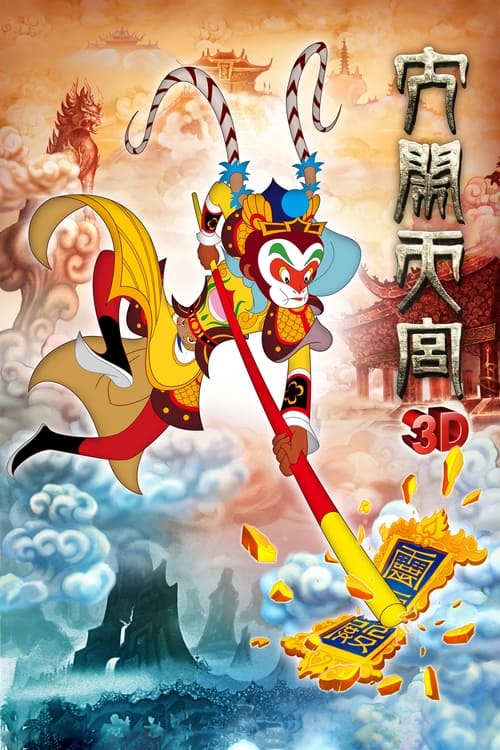
The Monkey King 3D: Uproar in Heaven
Plot
A completely remade animation film based on the original 1961 animation The Monkey King. Mythical ancient China. Born from some magic stones that fell to Earth a long time ago when Goddess Nüwa mended the sky, Sun Wukong, aka Monkey King, sets off on his first adventure to gain a worthy weapon. This earns the attention of the Jade Emperor of Heaven.
Get the Weekly Woke Watchlist
New and trending movies scored for woke bias, preachy messaging, and forced political themes — before you waste your evening.
No spam. One useful email per week.
Overall Series Review
Categorical Breakdown
The film’s focus is on character merit, skill, and power. The protagonist is a mythological being rebelling against an established celestial order based on feudal hierarchy, not an intersectional one. The cast is entirely composed of traditional Chinese mythological figures, meaning modern 'whiteness' vilification or 'race-swapping' is non-existent. Character is judged by the content of their soul and their refusal to submit to arbitrary authority.
The movie is a painstaking restoration of a Chinese national cultural treasure and celebrates the unique aesthetics of classic Chinese animation and Peking opera. It does not exhibit hostility toward its own civilization or ancestors. The target of critique is the Celestial Hierarchy, which represents a corrupt feudal power structure, not the culture, nation, or fundamental institutions.
The main action and conflict are centered around the male protagonist, Sun Wukong, and the male-dominated Celestial Court figures like the Jade Emperor and Heavenly Generals. There are no 'Girl Boss' or 'Mary Sue' tropes. Female characters like the Queen Mother occupy traditional mythological roles without anti-natalist or male-emasculating messaging.
The story is a straightforward mythological adventure based on a classic 16th-century Chinese novel. It focuses purely on action, mischief, and rebellion against authority. There is no presence of alternative sexual ideology, deconstruction of the nuclear family, or modern gender theory.
The protagonist literally fights against the gods and celestial bureaucracy, which can be seen as anti-clerical or anti-establishment. However, this is a critique of a corrupt system of power personified by the gods as a 'feudal government,' not a promotion of subjective moral relativism or an attack on the spiritual world itself. The protagonist is a powerful, spiritual being from a rich mythological tradition. The film acknowledges a higher moral law: tyranny is wrong, and true worth and freedom are good. The score is low because the hostility is toward corrupt authority, not transcendent morality.
Get the Weekly Woke Watchlist
New and trending movies scored for woke bias, preachy messaging, and forced political themes — before you waste your evening.
No spam. One useful email per week.