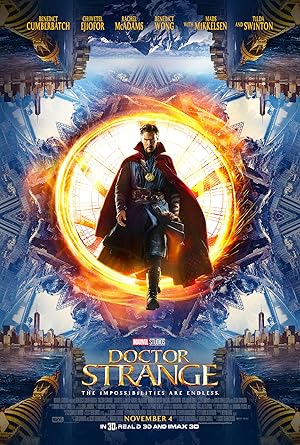
Doctor Strange
Plot
Marvel's "Doctor Strange" follows the story of the talented neurosurgeon Doctor Stephen Strange who, after a tragic car accident, must put ego aside and learn the secrets of a hidden world of mysticism and alternate dimensions. Based in New York City's Greenwich Village, Doctor Strange must act as an intermediary between the real world and what lies beyond, utilising a vast array of metaphysical abilities and artifacts to protect the Marvel Cinematic Universe.
Get the Weekly Woke Watchlist
New and trending movies scored for woke bias, preachy messaging, and forced political themes — before you waste your evening.
No spam. One useful email per week.
Overall Series Review
Categorical Breakdown
The movie features a key instance of race and gender-swapping with the Ancient One, who is a male Tibetan monk in the comics but is cast as a white, Celtic woman in the film. This change, which the studio defended as an effort to avoid the 'wizened old wise Asian man' stereotype and a Tibetan political dispute, aligns with forced insertion of diversity and historical race-swapping. The core protagonist is a white male who travels to an exotic non-Western locale to be saved and taught by a non-white-male-identifying figure, which frames a narrative relying on immutable characteristics to subvert expectation, rather than a purely colorblind meritocracy.
The central dramatic engine is the failure of the Western scientific, rational worldview, championed by the arrogant white male protagonist, and his need to humble himself by traveling to a non-Western land (Nepal) to learn a mystical, Eastern-inspired system of belief and power. This structure portrays a kind of Noble Savage trope where the West is depicted as incomplete, materialistic, and spiritually inferior, while the esoteric Eastern-inspired culture is superior, spiritually whole, and holds the key to the universe's defense. The protagonist must completely abandon his 'home' culture's science to progress.
The most powerful figure and primary mentor, the Ancient One, is a woman, replacing a male character from the source material. This immediately places a woman in the ultimate 'Girl Boss' position of power, training an initially incompetent male successor. The main female non-powered character, Christine Palmer, is a highly-skilled professional equal (a fellow surgeon) whose primary relationship with the hero is as a platonic anchor to his humanity, specifically subverting the traditional role of a love interest. The narrative focuses on career fulfillment and saving the world, with no mention of family or anti-natalism.
The narrative contains no explicit sexual ideology. Traditional male-female pairing and the nuclear family are not the central focus, but they are not actively deconstructed or vilified, as the primary relationship is purely professional and the hero's arc is solitary. The only ambiguous element is the Ancient One's androgynous appearance and casting, which has been cited as a subtle nod to non-binary identity, but this is a background characteristic and not a plot point or a lecture on gender theory.
The movie is actively anti-materialist and anti-atheist, setting up the main character's initial worldview as one of the problems he must overcome. He is wrong for believing humans are 'merely a tiny, momentary speck within an indifferent universe.' The film validates the reality of the spiritual, transcendent, and metaphysical realm. This functions more as a promotion of New Age/Eastern-inspired occultism and a rejection of scientism than a hostility toward traditional religion, especially since a clear objective evil force (Dormammu) exists, establishing a higher moral law in the universe.
Get the Weekly Woke Watchlist
New and trending movies scored for woke bias, preachy messaging, and forced political themes — before you waste your evening.
No spam. One useful email per week.