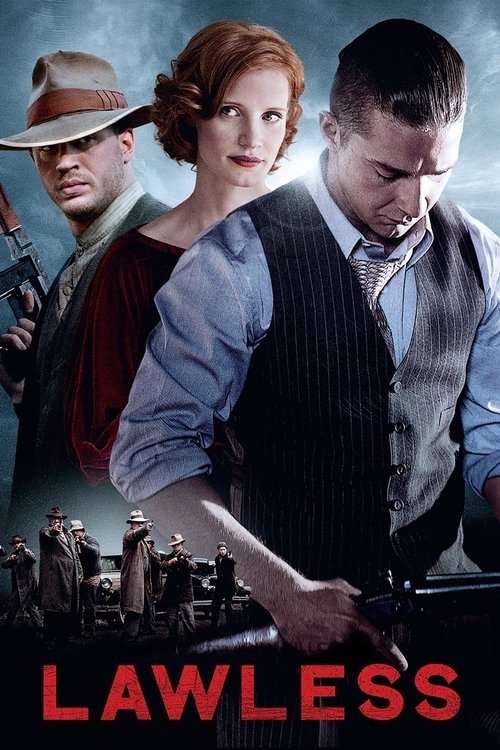
Lawless
Plot
In 1931, the Bondurant brothers of Franklin County, Virginia, run a multipurpose backwoods establishment that hides their true business — bootlegging. Middle brother Forrest is the brain of the operation; older Howard is the brawn, and younger Jack, the lookout. Though the local police have taken bribes and left the brothers alone, a violent war erupts when a sadistic lawman from Chicago arrives and tries to shut down the Bondurants operation.
Get the Weekly Woke Watchlist
New and trending movies scored for woke bias, preachy messaging, and forced political themes — before you waste your evening.
No spam. One useful email per week.
Overall Series Review
Categorical Breakdown
The narrative focuses entirely on the internal conflict and personal merit (specifically, the capacity for violence and survival) of the Bondurant brothers against a corrupt federal agent. The core cast is entirely composed of white characters, which is historically authentic to the setting of rural 1930s Franklin County, Virginia. Plot drivers revolve around money, power, and personal honor, not race or intersectional hierarchy. There is no vilification of 'whiteness' or forced diversity.
The movie is essentially an ode to the local culture and the anti-authoritarian spirit of Appalachian bootleggers. The narrative sets up the brothers, flawed as they are, as the protagonists to be rooted for against the external, corrupting influence of centralized law enforcement from the city. The film romanticizes and celebrates the Bondurant family, their territory, and their inherited code of survival, which is the inverse of civilizational self-hatred.
The core of the story is an intensely masculine drama centered on the three brothers. Female characters serve mainly as love interests and anchors for the male protagonists. Maggie acts as a source of emotional connection and a caretaker figure for Forrest. Bertha, a preacher's daughter, is the innocent object of Jack's romantic aspirations. The women are not portrayed as 'Girl Boss' figures but rather as complementary to the men, and the film concludes with a traditional vision of family and fatherhood.
The movie adheres strictly to a normative structure, centered on traditional male-female pairings and the nuclear family as the ultimate outcome for the surviving characters. Sexual ideology is absent from the plot and themes. The villain, Charlie Rakes, is portrayed with effeminate mannerisms as a sign of his corrupt and 'degenerate' nature, which functions as a traditional, non-woke trope for villainy.
Religion is present in the film as a fixture of the community life through the character of Bertha, the Brethren preacher's daughter. Faith and the church are treated as a real, existing, and normative institution within the setting, which the protagonist Jack interacts with and respects in his own way. The film acknowledges the traditional spiritual and moral framework without seeking to demonize or lecture against it.
Get the Weekly Woke Watchlist
New and trending movies scored for woke bias, preachy messaging, and forced political themes — before you waste your evening.
No spam. One useful email per week.