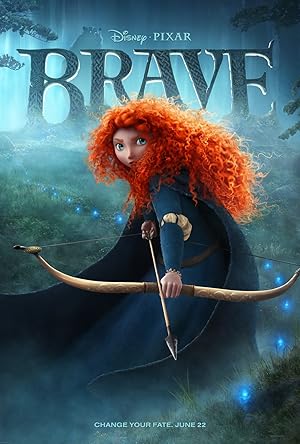
Brave
Plot
Set in Scotland in a rugged and mythical time, this movie features Princess Merida (Kelly Macdonald), an aspiring archer and impetuous daughter of Queen Elinor (Dame Emma Thompson). Merida makes a reckless choice that unleashes unintended peril and forces her to spring into action to set things right.
Get the Weekly Woke Watchlist
New and trending movies scored for woke bias, preachy messaging, and forced political themes — before you waste your evening.
No spam. One useful email per week.
Overall Series Review
Categorical Breakdown
The film’s casting is historically authentic to its Scottish setting, focusing the conflict entirely within a white, homogenous culture. There is no forced diversity or vilification of 'whiteness' as a whole. Merit is celebrated through Merida’s archery skill, which is superior to that of the male suitors. The score is raised slightly because the male clan leaders and King Fergus are largely depicted as incompetent, impulsive, and buffoonish, serving as foils to the competence of the female protagonists.
The film does not frame its home culture of Scottish clan society as fundamentally corrupt or racist. It heavily critiques the restrictive tradition of arranged marriage and the violent, feckless nature of the male-dominated political structure. The story, however, concludes with a reconciliation that adapts, rather than destroys, the heritage, ultimately strengthening the family and the alliances. The culture's folklore, land, and ancestors (the legendary bear) are shown as powerful and integral, which prevents the score from being high.
The core plot is a direct challenge to a 'patriarchal' society's gender norms, specifically rejecting the 'motherhood is a prison' theme by focusing on a complex mother-daughter bond. Merida is a perfect example of a 'Girl Boss' who instantly excels in traditionally masculine skills, refusing the obligation of marriage and romantic motivation entirely to pursue her own path. The men in the story are consistently portrayed as bumbling, short-sighted, and only capable of violence or food consumption, which serves to elevate the intelligence and capability of the female leads.
The narrative's central victory is Merida’s freedom from the expectation of marriage and a romantic partner, which is seen as a radical departure from the ‘heteronormative’ Disney tradition. There is no explicit presentation or lecturing on alternative sexualities or gender ideology; the focus is solely on a young woman’s right to self-determination. The rejection of the standard nuclear family endgame for the protagonist is the only element that moves the score above the minimum.
The spiritual vacuum is filled entirely by a focus on Celtic paganism, including a Witch, Will O’ the Wisps, and a connection to a legendary bear, rather than a critique of traditional Western religion. Christian faith is entirely absent from the story, and the morality is transcendent in the sense that breaking an ancient spiritual law (the curse) has immediate, objective, and negative consequences that must be set right by 'mending the bond' through love and apology.
Get the Weekly Woke Watchlist
New and trending movies scored for woke bias, preachy messaging, and forced political themes — before you waste your evening.
No spam. One useful email per week.