21 Jump Street
Plot
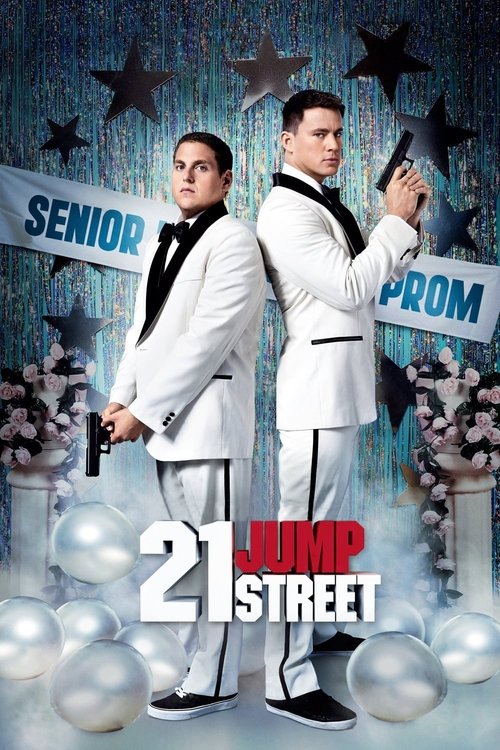
When cops Schmidt and Jenko join the secret Jump Street unit, they use their youthful appearances to go undercover as high school students. They trade in their guns and badges for backpacks, and set out to shut down a dangerous drug ring. But, as time goes on, Schmidt and Jenko discover that high school is nothing like it was just a few years earlier -- and, what's more, they must again confront the teenage terror and anxiety they thought they had left behind.
Get the Weekly Woke Watchlist
New and trending movies scored for woke bias, preachy messaging, and forced political themes — before you waste your evening.
No spam. One useful email per week.
Overall Series Review
Categorical Breakdown
The narrative structure is built on an overt, explicit inversion of social status where Jenko, the white, traditional alpha-male jock, loses all social standing, and his past behavior (e.g., punching a 'gay Black kid' in a high school memory) is framed as the ultimate transgression and a ‘sin of the first order’ in the modern, progressive high school. This functions as a clear vilification of a specific, old model of 'whiteness' and traditional male privilege. The command center is run by Captain Dickson, an 'angry black man' stereotype who acknowledges the trope for a joke, which uses race for self-aware comedy.
The central dramatic irony comes from the hostility toward the immediate past culture—the 'old' high school social order—which is portrayed as fundamentally corrupt, judgmental, and based on aggression and bullying. Jenko’s traditional masculine 'heritage' is deconstructed and shown to be a societal error of the past that must be replaced by a new, empathetic order that values 'environmental activism, tolerance, and good grades.' This critique frames the culture Jenko came from as inferior and embarrassing.
The main focus is the emasculation and subsequent re-education of Jenko's traditional male character, which is the primary form of gender-dynamic critique. His physical dominance and 'don't-care' masculinity are shown as weaknesses, while Schmidt's emotional and intellectual qualities become 'cool.' The film pushes the idea that 'you don't have to be traditionally masculine in order to be masculine' while simultaneously celebrating a hyper-masculine, though reformed, 'bromance.' The female lead is not a 'Girl Boss' but serves as a typical romantic interest, reducing her role in the gender critique beyond being part of the 'new cool' scene.
The high school culture Jenko encounters explicitly establishes that 'gays and intellectuals are cool,' making tolerance a new virtue. The comedy features repeated jokes that 'torque the gay subtext of male bonding into overdrive,' with the main duo’s friendship frequently being joked about in overtly sexual and homoerotic terms, sometimes 'skat[ing] a stoned, wobbly line' between affirming and offensive humor. Sexual identity is a noted element of the new social hierarchy, but not the primary narrative focus.
Religion is overtly mocked and treated ambivalently. The police unit's headquarters is an abandoned Korean-American church. Schmidt attempts a 'confused' prayer before a 'Korean Jesus' figure, expressing doubt about the figure's existence, and is mocked and told by his captain that 'Korean Jesus' is too busy for his 'sh_t.' The new drug the cops are after is irreverently named 'Holy Fucking Shit.' The film’s pervasive use of obscenity and crude language also signals a rejection of any transcendent moral law in favor of subjective, shock-based humor.
Get the Weekly Woke Watchlist
New and trending movies scored for woke bias, preachy messaging, and forced political themes — before you waste your evening.
No spam. One useful email per week.