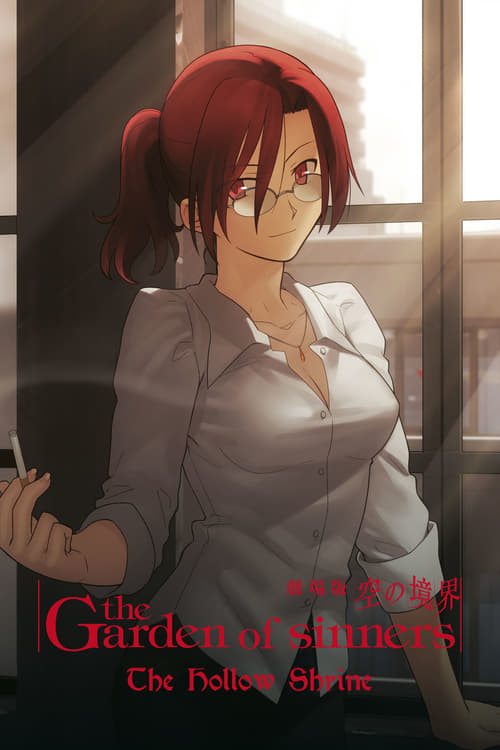
The Garden of Sinners: The Hollow Shrine
Plot
June 1998: After spending two years in a coma caused by a traffic accident, Shiki Ryougi awakens with amnesia. She is visited by Touko Aozaki, a wizard and proprietor of a studio called Garan no Dou. Shiki has lost not only the memory of her accident, but also any real sense that she's even alive. Strangely, enigmatic beings begin to attack her...
Get the Weekly Woke Watchlist
New and trending movies scored for woke bias, preachy messaging, and forced political themes — before you waste your evening.
No spam. One useful email per week.
Overall Series Review
Categorical Breakdown
Characters are judged by their metaphysical abilities and emotional depth, reflecting Universal Meritocracy. The movie is set in Japan with Japanese characters, avoiding any themes of 'race-swapping' or vilification of 'whiteness.'
The narrative is set in contemporary Japan, focusing on a supernatural struggle that does not involve a critique or demonization of the nation's culture, heritage, or institutions. The conflict is existential and personal, not civilizational.
The movie features a highly capable, business-owning female wizard (Touko) and a powerful, combat-oriented female protagonist (Shiki). Shiki is deeply flawed and traumatized, preventing a 'Mary Sue' depiction. The central male figure, Mikiya, provides a grounding, compassionate influence, making the dynamic complementary rather than strictly a 'Girl Boss' narrative with emasculated men.
The main character's struggle involves the loss of her internal male personality (SHIKI) following her coma, a concept that touches on gender duality and personal identity. This is presented as an esoteric, psychological/mystical condition unique to her family lineage, without promoting or lecturing on contemporary queer theory or deconstructing the nuclear family as a social structure.
The plot actively engages with themes of the soul, sin, death, and 'The Root' (Akasha), establishing an objective, transcendent spiritual reality in the form of a detailed mystical cosmology. The existence of objective spiritual law and magical power is a central component of the story, not a subject of vilification or moral relativism.
Get the Weekly Woke Watchlist
New and trending movies scored for woke bias, preachy messaging, and forced political themes — before you waste your evening.
No spam. One useful email per week.