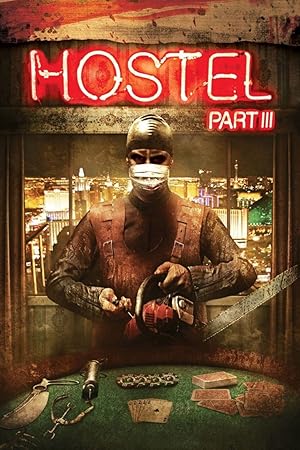
Hostel: Part III
Plot
While attending a bachelor party in Las Vegas, four friends are enticed by two sexy escorts to join them at a private party way off the Strip. Once there, they are horrified to find themselves the subjects of a perverse game of torture, where members of the Elite Hunting Club are hosting the most sadistic show in town.
Get the Weekly Woke Watchlist
New and trending movies scored for woke bias, preachy messaging, and forced political themes — before you waste your evening.
No spam. One useful email per week.
Overall Series Review
Categorical Breakdown
The narrative focuses on class and financial corruption, where wealthy patrons of various backgrounds pay to torture others for sport. The victims are primarily young white males, and the main villain is also a white male friend, suggesting the depravity is universal and based on individual moral choices and wealth, not an intersectional hierarchy. Character merit is judged by whether a person is a victim or a willing participant in the violence.
The plot shifts the torture enterprise from a foreign setting (Eastern Europe) to Las Vegas, USA. This move serves to directly frame 'America's playground' as a place of profound moral decay, excess, and human depravity. The horror is explicitly located 'here at home,' critiquing the spiritual bankruptcy of a wealthy, consumer-driven Western society.
The story centers on a bachelor party, a fundamentally male-focused event, and the women involved are either escorts (lures/objects of desire) or the groom's off-screen fiancée. The narrative does not contain any 'Girl Boss' or 'Mary Sue' tropes. The focus is on the failure of male friendship and personal fidelity, and there is no overt anti-natalist or anti-family message, despite the negative representation of the bachelor party's moral environment.
The narrative is centered on a traditional heterosexual bachelor party, involving a groom-to-be and his male friends who are lured by female escorts. There is no presence of alternative sexual ideologies, deconstruction of the nuclear family unit, or gender theory lecturing. The structure remains strictly normative.
The film deals with extreme moral depravity—the torture and murder of innocents for sport and profit—which implicitly demonstrates a moral vacuum and a lack of objective truth among the villains. However, the plot contains no overt hostility toward organized religion, specifically Christianity, nor are religious figures used as villains or bigots. The spiritual vacuum is a result of greed and sadism, a standard horror theme.
Get the Weekly Woke Watchlist
New and trending movies scored for woke bias, preachy messaging, and forced political themes — before you waste your evening.
No spam. One useful email per week.