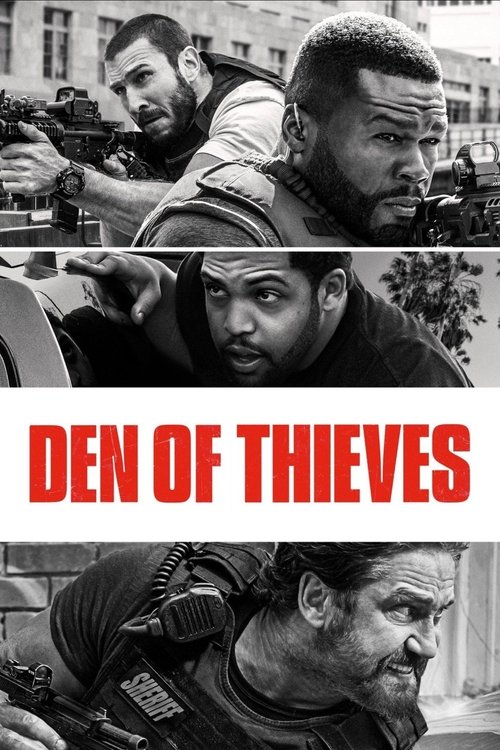
Den of Thieves
Plot
A gritty crime saga which follows the lives of an elite unit of the LA County Sheriff's Dept. and the state's most successful bank robbery crew as the outlaws plan a seemingly impossible heist on the Federal Reserve Bank.
Get the Weekly Woke Watchlist
New and trending movies scored for woke bias, preachy messaging, and forced political themes — before you waste your evening.
No spam. One useful email per week.
Overall Series Review
Categorical Breakdown
The narrative does not rely on an intersectional lens or privilege hierarchy to drive the conflict; the main themes are professional competence and moral corruption, which apply to all characters regardless of their race. The protagonist lawman is a white male who is depicted as a morally bankrupt, crude 'slimebag,' but his failings stem from his individual character and vice, not a lecture on 'whiteness' or systemic oppression. The antagonist crew of robbers is racially mixed and judged purely on their skill and discipline.
The film adopts a cynical view of contemporary institutions, portraying the elite police unit as corrupt and the Federal Reserve as an impersonal, almost abstract target ripe for theft. This suggests a degeneration of American culture and professionalism. However, it does not explicitly frame American institutions as fundamentally corrupt or racist, nor does it demonize ancestors or elevate other cultures as spiritually superior. The focus is on moral decay rather than civilizational self-hatred.
The movie is characterized by critics as excessively 'macho,' focusing overwhelmingly on male characters and their 'toxic masculinity.' Female characters are marginal, serving primarily as reactive figures in the male characters' personal subplots (e.g., the wife who leaves the protagonist for his infidelity, or a female stripper used for information). There is no presence of a 'Girl Boss' or 'Mary Sue' trope, and the script is criticized for sexism rather than adhering to modern feminist ideological mandates. The failure of the nuclear family is shown as a consequence of the male lead's vices.
No detectable presence of overt LGBTQ+ themes, characters, or ideological commentary is integrated into the plot. The film adheres to a normative structure by focusing on traditional male-female pairings (even if dysfunctional and promiscuous) and avoids engaging with 'Queer Theory' or gender ideology entirely.
The moral universe of the film is highly secular, amoral, and subjective, where the difference between the cop and the robber is one of function, not objective morality. The film lacks any clear transcendent moral compass. However, there is no direct, explicit hostility, vilification, or deconstruction of organized religion, specifically Christianity. The moral relativism is a vacuum rather than an active attack.
Get the Weekly Woke Watchlist
New and trending movies scored for woke bias, preachy messaging, and forced political themes — before you waste your evening.
No spam. One useful email per week.