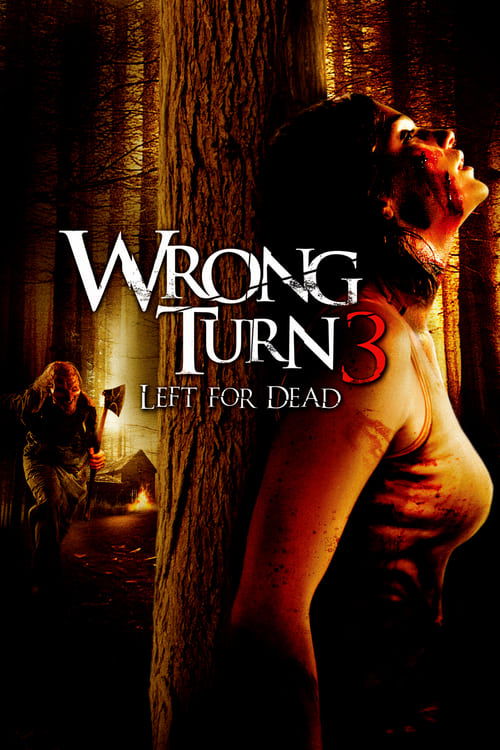
Wrong Turn 3: Left for Dead
Plot
A group of people find themselves trapped in the backwoods of West Virginia, fighting for their lives against a group of vicious and horribly disfigured inbred cannibals.
Get the Weekly Woke Watchlist
New and trending movies scored for woke bias, preachy messaging, and forced political themes — before you waste your evening.
No spam. One useful email per week.
Overall Series Review
Categorical Breakdown
The film utilizes a diverse cast of prisoners and guards, but their identities function primarily as archetypal criminal or law enforcement roles rather than tools for intersectional commentary. A neo-Nazi convict serves as a clear villain who is explicitly defined by a white supremacist ideology, which is a rare instance of race being central to a character's evil nature. However, the non-white characters are split between an undercover agent and a brutal crime boss, meaning merit (or lack thereof) supersedes immutable characteristics in determining who is good or evil. The core conflict is not a lecture on privilege but a straightforward clash between criminals, cops, and cannibals.
The central antagonists are deformed, inbred cannibals who represent the complete, monstrous devolution of a specific American regional/ancestral culture in the West Virginia backwoods. This leans into the 'Noble Savage' inversion by depicting rural 'heritage' as fundamentally corrupt and savage. The hero, Officer Nate Wilson, is an aspiring lawyer, indicating a movement away from his own background as a 'hick' from the area. The movie frames the environment and the local inhabitants as a pit of chaos and depravity from which the protagonists must escape, placing a strong emphasis on hostility toward the film's 'home' setting.
The main female character, Alex, is established as a victim and survivor whose primary story arc involves her being hunted and eventually saved through the protective actions of the male protagonist. Her depiction aligns with the traditional 'Final Girl' and damsel-in-distress tropes of the slasher genre, not a 'Girl Boss.' An early scene also features the gratuitous sexualization and swift death of a female character, serving as classic horror fodder. The film focuses heavily on the protective and aggressive masculinity of the various male figures, both good and bad, with no message against the nuclear family or in favor of career-as-fulfillment.
The film contains no detectable discussion of, or focus on, alternative sexualities, gender ideology, or the deconstruction of the nuclear family unit. The narrative is solely concerned with primal survival, violence, and greed. Sexual themes are limited to standard heterosexual horror tropes and do not involve political or academic sexual ideology. The structure adheres to a traditional, normative framework without any lecturing.
The plot is a simple survival horror story devoid of any religious or theological subplot. There are no Christian characters depicted as villains or bigots, nor is there an attack on traditional religion. The morality present in the film is entirely subjective to the situation of survival and the pursuit of money, with the characters' actions defined by their moral choices in a lawless environment. This absence of discussion means the movie neither critiques nor embraces transcendent morality, keeping it a straightforward action-horror narrative.
Get the Weekly Woke Watchlist
New and trending movies scored for woke bias, preachy messaging, and forced political themes — before you waste your evening.
No spam. One useful email per week.