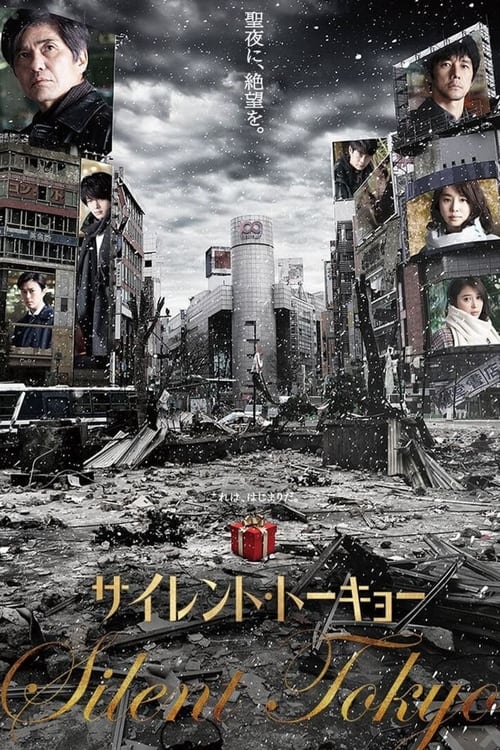
Silent Tokyo
Plot
On Christmas Eve, a TV broadcasting station receives a phone call. The caller warns "I have set up a bomb at Ebisu in Tokyo." A contract worker for the TV broadcasting station and a housewife are accused by the Ebisu police as being the culprits. During this chaotic situation, a mysterious man silently watches as everything unfolds. A video clip is then uploaded to an online video website. The video contains a demand to talk with the Prime Minister during a live broadcast or a bomb will be detonated at 6 pm in Shibuya, Tokyo. Who is behind the bombings and who will stop them?
Get the Weekly Woke Watchlist
New and trending movies scored for woke bias, preachy messaging, and forced political themes — before you waste your evening.
No spam. One useful email per week.
Overall Series Review
Categorical Breakdown
The movie is a domestic Japanese thriller with an entirely Japanese cast, which does not feature 'race-swapping' or a focus on ‘whiteness.’ Character roles, such as the detective, the bomber, and the housewife, are defined by their actions and involvement in the crime and political crisis, not by an intersectional hierarchy or immutable characteristics. The casting is culturally authentic and plot-driven.
The narrative is highly critical of the current Japanese government’s perceived move toward militarism, with the bomber being described as a 'peacenik' who challenges the 'bellicose prime minister.' This is a specific political critique directed at a modern system or ideology within Japan, framed as an anti-war message, rather than a condemnation of the nation’s history, ancestors, or core cultural values.
Gender dynamics follow a mostly traditional thriller model, featuring a grizzled male detective and a male bomber/villain. The main female characters are a housewife and an office worker who become victims of circumstance or are coerced into the plot, suggesting traditional roles in crisis but showing agency through their survival and involvement. There is no evidence of a 'Girl Boss' trope, the emasculation of male characters, or an explicit anti-natalist message.
The plot is entirely focused on the political thriller, the bomb threat, the police investigation, and the public reaction. There is no inclusion of LGBTQ+ themes, queer theory, centering of alternative sexualities, or discussion of gender ideology. The traditional male-female pairing and nuclear family structure are neither deconstructed nor criticized within the narrative's central conflict.
The movie is set on Christmas Eve, which functions only as a temporal and visual setting for a massive urban thriller; it capitalizes on the crowds for the bomb target. The conflict is political, social, and criminal, not theological. There is no evidence of hostility toward religion, specifically Christianity, or that faith-based morality is presented as subjective 'power dynamics.' Transcendent morality is neither central nor attacked.
Get the Weekly Woke Watchlist
New and trending movies scored for woke bias, preachy messaging, and forced political themes — before you waste your evening.
No spam. One useful email per week.