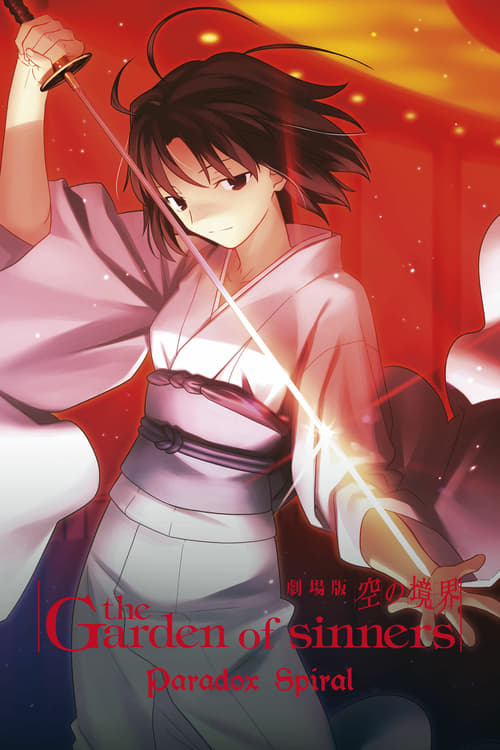
The Garden of Sinners: Paradox Spiral
Plot
Tomoe Enjou is attacked by bullies from his old school and saved by Shiki Ryougi. He asks her to hide him at her place and admits that he killed someone. Several days later, there are still no broadcasts about the murder as if it didn't happen... and when the victims are found, they're alive and unharmed.
Get the Weekly Woke Watchlist
New and trending movies scored for woke bias, preachy messaging, and forced political themes — before you waste your evening.
No spam. One useful email per week.
Overall Series Review
Categorical Breakdown
The narrative makes no reference to race, systemic oppression, or intersectional hierarchy; all main characters are Japanese. Character value is based entirely on psychological complexity, innate magical abilities (like Mystic Eyes of Death Perception), and personal choices, embodying the concept of universal meritocracy. The plot is focused on existential and metaphysical battles, not social commentary on privilege or immutable characteristics.
The setting is modern Japan, and the story does not frame Japanese culture or civilization as fundamentally corrupt or racist. While the plot involves a critique of dysfunctional, abusive 'traditionalist families' that force expectations onto their children, the ultimate defeat of the nihilistic villain is achieved through an affirmation of 'simple familial love,' which is a traditional, anti-nihilist value. There is no 'Noble Savage' trope or demonization of the home culture.
The main protagonist, Shiki Ryougi, is an extremely capable, powerful female lead and an active fighter, but she is not a 'Mary Sue'; her power is balanced by a deep, internal psychological struggle with her multiple personalities and inherent murderous impulses. The movie features another powerful female Magus, Touko Aozaki, who is a successful businesswoman and combatant. The character arc for Shiki, over the series, culminates in a desire for a 'normal life' and a relationship with her male partner, affirming a complemetarian view of gender roles and connection, not an anti-natalist or anti-family message.
The character of Shiki has two main personalities—one female (Shiki) and one associated with a male tone/persona (SHIKI)—which is a supernatural-psychological trope rooted in the Eastern concept of Taiji (Yin and Yang) and the Jungian Anima/Animus. This internal duality touches on gender ambiguity but is not an endorsement or lecture on contemporary gender ideology or queer theory. Sexuality remains a private, character-specific struggle linked to philosophical themes, and the nuclear family is not presented as 'oppressive' but as a desired, normative structure for the protagonists.
The movie's philosophy focuses on Eastern concepts like Taiji, the Spiral of Origin (The Root, a non-religious cosmological concept), and the meaning of existence. The antagonist's goal is to find an objective pattern in all human deaths, a form of nihilistic hubris, which is directly contrasted with a transcendent moral value: the power of human connection and love. The story's spiritual themes are complex and metaphysical, not anti-theistic, and there is no specific vilification of Christianity or other major traditional religions.
Get the Weekly Woke Watchlist
New and trending movies scored for woke bias, preachy messaging, and forced political themes — before you waste your evening.
No spam. One useful email per week.