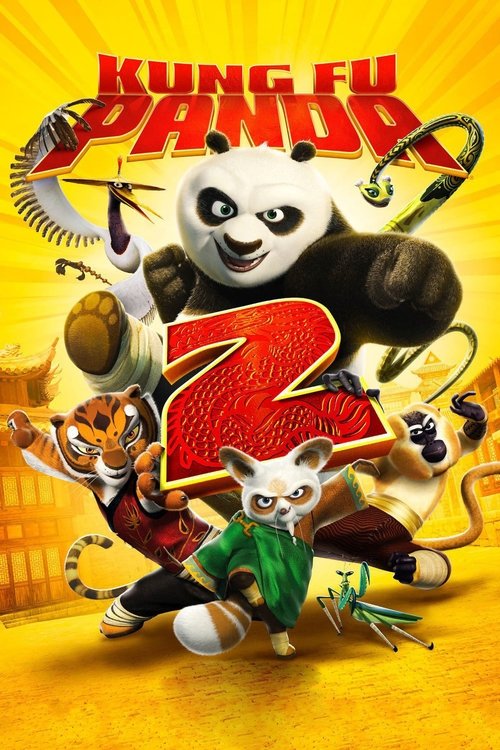
Kung Fu Panda 2
Plot
Po and his friends fight to stop a peacock villain from conquering China with a deadly new weapon, but first the Dragon Warrior must come to terms with his past.
Get the Weekly Woke Watchlist
New and trending movies scored for woke bias, preachy messaging, and forced political themes — before you waste your evening.
No spam. One useful email per week.
Overall Series Review
Categorical Breakdown
The plot's central conflict revolves around Po’s identity, but this is explored through the lens of adopted versus biological family and overcoming childhood trauma, not through racial or intersectional hierarchy. The story concludes that true identity comes from choosing who you are and embracing the love of your family, regardless of species (an anthropomorphic analogy for race). Characters are defined entirely by their mastery of kung fu and their moral character, adhering to the principle of Universal Meritocracy.
The film demonstrates deep respect and appreciation for the setting, which is a mythical, universalized version of ancient China, its architecture, and its cultural tradition of Kung Fu. The main antagonist, Lord Shen, is explicitly trying to conquer China and destroy the foundational cultural institution of Kung Fu by replacing it with a new, destructive modern technology (cannons). The heroes defend their home, ancestors, and core institutions, which aligns with Gratitude and Chesterton’s Fence.
Female characters like Tigress are established, competent, and respected martial arts masters who contribute equally to the mission. Their strength is simply a fact of their character, not a tool for a 'Girl Boss' lecture or the systematic emasculation of the male characters. Po, the male protagonist, finds his emotional arc through confronting vulnerability, which grants him 'inner peace,' a sign of emotional depth, not bumbling incompetence. The memory of Po's biological mother is a celebration of maternal sacrifice and protection.
The narrative's focus is on the power of adopted family (a goose raising a panda) and Po's quest to reconcile with his traditional biological family origins. The sexual identity of the characters is completely irrelevant to the plot and is not centered. The structure is overwhelmingly Normative, reinforcing the theme of family bonds without any lecturing on alternative sexualities or gender theory.
The core theme is Po's quest for 'inner peace,' a spiritual, transcendent concept rooted in Eastern philosophy (Taoism/Buddhism) that provides an objective path to moral and physical strength. The film acknowledges a higher moral law (saving China, protecting the innocent) and embraces a non-Western spiritual element (finding inner peace) as the ultimate source of power, rather than promoting moral relativism or hostility toward religion.
Get the Weekly Woke Watchlist
New and trending movies scored for woke bias, preachy messaging, and forced political themes — before you waste your evening.
No spam. One useful email per week.