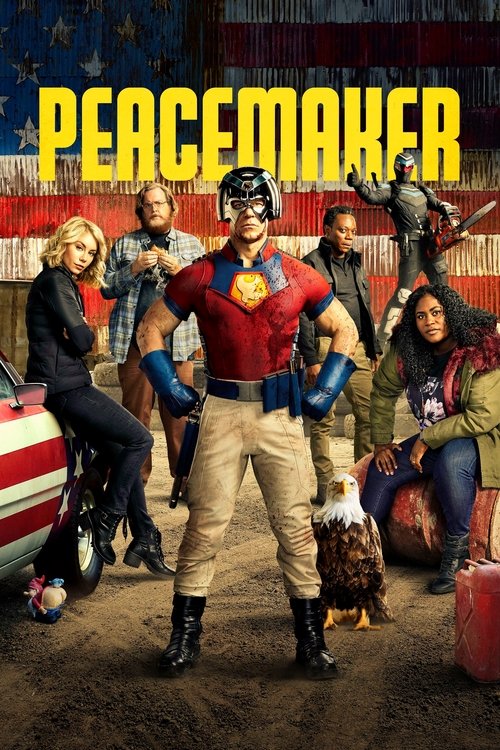
Peacemaker
Season 1 Analysis
Season Overview
After surviving being shot and then buried beneath a collapsing building, Peacemaker returns home only to realize that his freedom comes at a price. He is now part of Amanda Waller's new team fighting a mysterious new threat. Can he eliminate the threat without making things worse?
Season Review
Categorical Breakdown
The main human villain, Auggie Smith (White Dragon), is a cartoonishly vile, explicit white supremacist, making the ultimate evil a caricature of 'whiteness.' The protagonist, a white male, must literally kill his father to complete his redemption. The most overt lecture on systemic issues involves a Black, lesbian character telling the white male protagonist of the 'agony the straight white dude goes through' when asked to use inclusive language. The entire heroic team is built around a non-white, intersectionally diverse cast that is either more competent or more morally sound than the white male lead.
The alien antagonists, the Butterflies, are revealed to be refugees whose motivation is to take over the planet's leadership because they view Earth's governments, implicitly Western ones, as terminally corrupt and driving the world toward self-destruction. This frames a foreign, totalitarian 'Other' as having a moral justification for intervention against a deeply flawed, self-destructive Western civilization. The protagonist's personal jingoism is presented as a mask for profound psychological damage.
The main male protagonist is a bumbling, emotionally stunted, and sexually inept figure who is frequently ridiculed or corrected by the female characters. Female leads like Emilia Harcourt are highly effective, stoic agents who are superior in competence and lethality. Leota Adebayo is established as the clear moral compass and the one who ultimately exposes the manipulative corruption of Amanda Waller, another powerful female character. The narrative consistently presents the female characters as morally and professionally superior to the men.
Alternative sexualities are a core part of the main cast's identities. Leota Adebayo, one of the central heroes and the team's moral conscience, is a lesbian in a stable, established marriage. The title character, Peacemaker, is explicitly stated by the creators and confirmed in the show's dialogue to be bisexual. The inclusion of these alternative sexualities is centered through two of the show's main characters, not relegated to minor or tertiary roles.
There is no direct vilification of religion, and the main character is noted as being Christian. However, the source of moral conflict is strictly psychological trauma and secular ideologies (jingoism, white supremacy, totalitarianism). The final conflict is a choice between mind-controlled 'peace' and messy free will, which is a secular moral dilemma about self-determination and conscience, rather than a conflict involving or guided by transcendent moral law or faith.