The Expendables
Plot
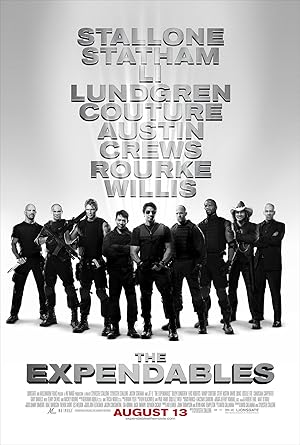
Barney Ross leads the "Expendables", a band of highly skilled mercenaries including knife enthusiast Lee Christmas, martial arts expert Yin Yang, heavy weapons specialist Hale Caesar, demolitionist Toll Road and loose-cannon sniper Gunner Jensen. When the group is commissioned by the mysterious Mr. Church to assassinate the merciless dictator of a small South American island, Barney and Lee head to the remote locale to scout out their opposition. Once there, they meet with local rebel Sandra and discover the true nature of the conflict engulfing the city. When they escape the island and Sandra stays behind, Ross must choose to either walk away and save his own life - or attempt a suicidal rescue mission that might just save his soul.
Get the Weekly Woke Watchlist
New and trending movies scored for woke bias, preachy messaging, and forced political themes — before you waste your evening.
No spam. One useful email per week.
Overall Series Review
Categorical Breakdown
The team is racially diverse, consisting of white, Black, and Asian members, but their inclusion is based on their status as action stars and elite fighting skills, reflecting universal meritocracy. The villain is a corrupt ex-CIA agent, a white American, which frames the conflict as corruption versus skill, not race versus race, avoiding any lecture on whiteness or privilege. There is no forced insertion of diversity; the characters are defined by their job.
The central antagonist is a corrupt ex-CIA agent, a rogue American figure who exploits a small South American island for a drug operation, which offers a critique of American government overreach. However, the American/Western heroes ultimately act as liberators, choosing to fight the corruption to save the innocent, which mitigates any outright hostility toward the home culture. The overall tone is a celebration of a classic, visceral Western action movie archetype.
Women exist primarily as moral anchors or damsels in distress to motivate the male heroes. The main hero, Barney Ross, returns for a 'suicidal rescue mission' to save the female contact, Sandra, who is helpless after the team abandons the mission. The heroes' moral code is explicitly shown when they identify the villains as 'bad men' who are 'willing to hit women,' strongly reinforcing a traditional, protective view of masculinity. There is no 'Girl Boss' or anti-natalist messaging.
The movie operates in a hyper-masculine action space. There is no presence or centering of alternative sexualities, sexual ideology, or gender theory. The narrative is overtly heteronormative, with the male-female pairing as the standard and no deconstruction of the nuclear family unit or focus on transitioning.
There is no overt hostility toward religion. Barney Ross's decision to return for the rescue is framed as an act to 'save his soul,' implying a recognition of a higher moral conscience and a need for redemption. The film's moral code is simplistic and transcendent (a vague sense of right and wrong, don't hit women) but is not portrayed as subjective 'power dynamics' or as the root of evil.
Get the Weekly Woke Watchlist
New and trending movies scored for woke bias, preachy messaging, and forced political themes — before you waste your evening.
No spam. One useful email per week.