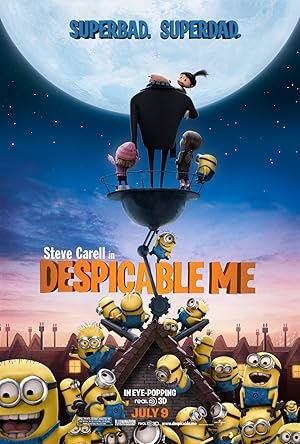
Despicable Me
Plot
In a happy suburban neighborhood surrounded by white picket fences with flowering rose bushes, sits a black house with a dead lawn. Unbeknownst to the neighbors, hidden beneath this house is a vast secret hideout. Surrounded by a small army of minions, we discover Gru (Steve Carell), planning the biggest heist in the history of the world. He is going to steal the moon. Gru delights in all things wicked. Armed with his arsenal of shrink rays, freeze rays, and battle-ready vehicles for land and air, he vanquishes all who stand in his way. Until the day he encounters the immense will of three little orphaned girls who look at him and see something that no one else has ever seen: a potential Dad. The world's greatest villain has just met his greatest challenge: three little girls named Margo (Miranda Cosgrove), Edith (Dana Gaier), and Agnes (Elsie Fisher).
Get the Weekly Woke Watchlist
New and trending movies scored for woke bias, preachy messaging, and forced political themes — before you waste your evening.
No spam. One useful email per week.
Overall Series Review
Categorical Breakdown
Characters are judged entirely by their 'villain merit' or their capacity for love, not by immutable characteristics or race. The main conflict is between two male supervillains, Gru and Vector, whose motivations are personal ambition. The supporting cast, including the orphans and Gru's staff, presents a genuinely diverse and colorblind mix of characters without the narrative focusing on themes of systemic oppression or white vilification.
The central conflict resolves with the villain Gru choosing to stay in his suburban home and form a stable, loving, domestic family unit. His home and community, initially mocked through his black house and desire to avoid neighbors, become the place of his redemption. The film frames the creation of a good home and family as the ultimate goal, respecting the institution of the family as a shield against the chaos of his former life.
The female characters, the three girls, are the catalysts for the male protagonist's emotional growth, converting the villain into a nurturing father through their innocent love. Gru embraces traditionally feminine roles like reading bedtime stories, taking them to dance practice, and hosting tea parties. Masculinity is not depicted as toxic, but rather is refined and channeled into a protective, fatherly role. However, humor is derived from Gru and the male minions dressing in female attire, which reinforces traditional gender binaries for comic effect.
The movie follows a completely normative structure centered on a traditional nuclear family model, formed here through adoption by a male father figure. Sexual identity is entirely absent from the plot, and there is no discussion or centering of alternative sexualities or gender theory for the children's audience. The focus is exclusively on the strength and emotional importance of the parent-child bond.
The story operates in an amoral universe where grand larceny and cruelty are treated as normal career pursuits, suggesting a world of moral relativism that operates outside of objective, transcendent good. Gru's change comes from an internal, secular source (the 'power of love' for his daughters) rather than a religious awakening or acknowledgment of a divine moral law. This initial glorification of villainy and moral-free environment warrants a higher score, even though the final message is one of virtue over vice.
Get the Weekly Woke Watchlist
New and trending movies scored for woke bias, preachy messaging, and forced political themes — before you waste your evening.
No spam. One useful email per week.