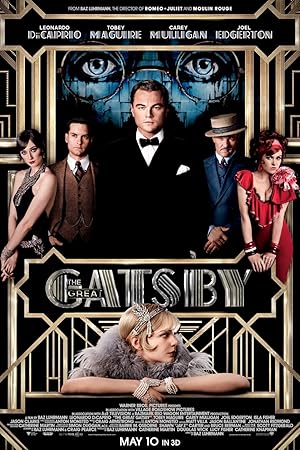
The Great Gatsby
Plot
An adaptation of F. Scott Fitzgerald's Long Island-set novel, where Midwesterner Nick Carraway is lured into the lavish world of his neighbor, Jay Gatsby. Soon enough, however, Carraway will see through the cracks of Gatsby's nouveau riche existence, where obsession, madness, and tragedy await.
Get the Weekly Woke Watchlist
New and trending movies scored for woke bias, preachy messaging, and forced political themes — before you waste your evening.
No spam. One useful email per week.
Overall Series Review
Categorical Breakdown
The narrative fundamentally critiques class structure and the dominance of the 'old money' white aristocracy over the 'new money' and working class. The main villain, Tom Buchanan, is a wealthy white male who explicitly expresses racist eugenics theories, and the story condemns his prejudice and moral carelessness. While a minor theme of systemic oppression exists through class and race commentary, the core plot judges characters like Gatsby and the Buchanans by their profound individual moral failures, not their immutable characteristics. The diverse background casting in party scenes does not constitute race-swapping of main characters.
The movie acts as a powerful moral indictment of the American Dream corrupted by materialism, greed, and moral vacuity, portraying the elite's culture as fundamentally corrupt and empty. This is an internal, self-critical American narrative focused on a specific time period's moral breakdown. The story deconstructs the moral failings of the wealthy class but does not frame American ancestors or Western civilization as wholly demonic, maintaining a classical literary tone of loss and cautionary tragedy.
Female characters are depicted primarily as accessories, limited, and objectified within a heavily patriarchal 1920s society, with the story critiquing their powerlessness. Daisy Buchanan is trapped between two toxic men and is not an autonomous figure or a 'Girl Boss.' Men like Tom Buchanan are depicted as powerful and toxic brutes, while Gatsby is an emasculated idealist, but not all male characters are bumbling idiots. The narrative points out the lack of fulfillment for women in this society rather than celebrating an anti-natalist or 'perfect female lead' message.
The entire dramatic focus centers on traditional heterosexual pairings (Tom/Daisy/Gatsby, Tom/Myrtle, Nick/Jordan). The movie does not introduce or center alternative sexualities, gender ideology, or deconstruct the nuclear family structure in its explicit narrative. Sexual identity is private and non-ideological, revolving around illicit affairs and traditional romantic obsession.
The film explicitly showcases the moral vacuum of a hedonistic society, with the 'Eyes of Doctor T.J. Eckleburg' billboard symbolizing a lost or forgotten moral/spiritual judgment overseeing the valley of ashes. The story's central theme is the decay and moral relativity of the wealthy who 'smash up things and creatures.' This is a spiritual crisis, showing a society that has lost its moral bearings, but it does not actively vilify traditional religion or depict Christian characters as bigots or villains; it focuses on the absence of a higher moral law.
Get the Weekly Woke Watchlist
New and trending movies scored for woke bias, preachy messaging, and forced political themes — before you waste your evening.
No spam. One useful email per week.