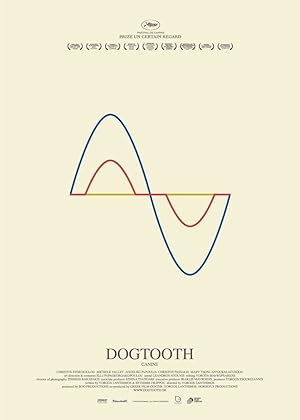
Dogtooth
Plot
Kept on a short leash through a volatile mixture of indoctrination, misinformation and fear, three grown-up siblings--two sisters and one brother--find themselves confined to their lavish, isolated villa. As a result, holed up in their beautiful, high-walled prison, the siblings rely on their cold, manipulative parents to learn about the ways of the world, taking reality-defying lessons from instructional cassette tapes. And, as the cruel patriarch and his frigid wife deliberately keep their unsuspecting, submissive children in the dark, freedom is nothing but a word. Then, a bad influence in the shape of security guard Christina enters the equation, and suddenly, sweet, baffling temptation threatens years of meticulous mind-programming. Is the grass greener on the other side of the fence? With this in mind, how can an ordinary dogtooth stand in the way of happiness?
Get the Weekly Woke Watchlist
New and trending movies scored for woke bias, preachy messaging, and forced political themes — before you waste your evening.
No spam. One useful email per week.
Overall Series Review
Categorical Breakdown
The narrative has no reliance on race, ethnicity, or intersectional hierarchy for its central conflict. Characters are not defined by immutable characteristics but by their relationship to the family's manufactured hierarchy of power and ignorance. The casting is naturally authentic to the film's Greek setting and is colorblind within its own cultural context.
The film fundamentally frames a core Western institution—the traditional nuclear family—as fundamentally corrupt, toxic, and totalitarian. The parents deliberately demonize the world outside their walls, yet the home itself is the true, psychologically damaging prison. The film is an explicit deconstruction of the concept of 'home' and the nuclear family as a safe, healthy institution, presenting the micro-society of the family as a monstrous, autocratic regime that must be escaped.
The Father figure is the 'cruel patriarch' whose absolute, controlling masculinity drives the entire system of repression, ultimately leading to the family’s breakdown and grotesque acts of abuse. The Mother is complicit and quietly submissive to the male authority. The core conflict is sparked by the burgeoning sexuality and eventual rebellion of the daughters, whose attempts at agency threaten the male-controlled order. The film critiques the traditional family structure by portraying it as a prison where male power is toxic and destructive.
Sexuality is a central theme, but it is focused on the grotesque regulation and exploitation of *hetero*sexuality by the parents as a tool for control. The narrative deconstructs the nuclear family not by centering alternative sexualities or gender ideology, but by showcasing the pathological extremes of a warped, repressive heterosexual structure. The focus is on perversion and control, not on affirming LGBTQ+ identity or deconstructing biological reality as bigotry.
The family operates in a spiritual vacuum, creating its own subjective 'mythology,' 'truth,' and moral code (e.g., cats are deadly beasts, and an airplane is a toy). The film demonstrates a purely man-made, arbitrary moral relativism where 'truth' is whatever the Father dictates and the only objective reality is the power dynamic. There is no explicit attack on religion, but the story strongly champions the idea that all transcendent, objective morality is a manipulative construct that can be easily replaced by arbitrary subjective power.
Get the Weekly Woke Watchlist
New and trending movies scored for woke bias, preachy messaging, and forced political themes — before you waste your evening.
No spam. One useful email per week.