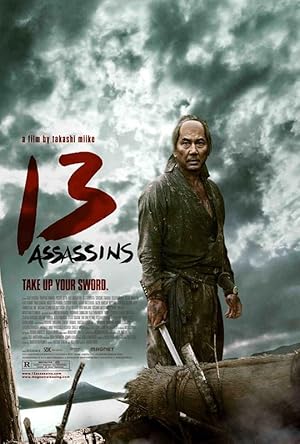
13 Assassins
Plot
In 1844, the peace of Feudal Japan is threatened by cruel Lord Naritsugu Matsudaira, who is politically rising and getting closer to his half-brother, the shogun. After the harakiri of the Namiya clan leader, samurai Shinzaemon Shimada is summoned by the shogun's advisor Sir Doi of the Akashi Clan to listen to the tragedy of Makino Uneme, whose son and daughter-in-law have been murdered by Naritsugu. Then Sir Doi shows a woman with arms, legs and tongue severed by Naritsugu and she writes with her forearm a request to Shinza to slaughter Naritsugu and his samurai. Shinza promises to kill Naritsugu and he gathers eleven other samurais and plots a plan to attack Naritsugu in his trip back to the Akashi land. But the cunning samurai Hanbei Kitou that is responsible for the security of his master foresees Shinza's intent. Shinza decides to go with his samurai through the mountain, where they find the hunter Koyata that guides them off the mountain and joins the group. Now the thirteen men prepare an ambush to Naritsugu and his army of two hundred samurai in a suicide mission to stop evil.
Get the Weekly Woke Watchlist
New and trending movies scored for woke bias, preachy messaging, and forced political themes — before you waste your evening.
No spam. One useful email per week.
Overall Series Review
Categorical Breakdown
The film is an authentic Japanese period piece where all main characters are Japanese men, focused on an internal power struggle between samurai and a corrupt lord. Character valuation rests entirely on courage, loyalty, and skill, representing universal meritocracy. There is no trace of 'whiteness' vilification or forced insertion of diversity.
The narrative scrutinizes the traditional feudal system and the unquestioning nature of Bushido (samurai code of honor), revealing how they can be exploited to enable horrific sadism from Lord Naritsugu. Shinzaemon, the lead samurai, is shown to be 'delighted' by the chance for one last war, suggesting a critique of the samurai's existence as a class during peacetime. The critique is internal to the Japanese culture, deconstructing the *romanticized* samurai myth, but the heroes' action to protect the people prevents it from being a total indictment of the nation's moral core.
The cast is overwhelmingly male, concentrating entirely on samurai duty, combat, and rivalry. The primary female presence is an early victim of the villain's savagery—a plot device used to motivate the male protagonists—which is the antithesis of the 'Girl Boss' trope. The narrative treats women as subjects to be protected, reinforcing a complementarian view of masculine and protective roles.
The story is a classical period-piece military drama focused on political maneuvering and combat strategy. No alternative sexual identities are centered or discussed, and the narrative does not deconstruct the nuclear family or lecture on gender ideology. It maintains a normative structure for the time period depicted.
The central conflict revolves around political duty, the social hierarchy of the Shogunate, and the code of Bushido, not religious faith. The motivation is to stop a clear, objective evil that threatens the nation's peace. The thirteenth assassin, Koyata, is a wild man/spirit who explicitly critiques the samurai's 'holier than thou attitude' and strict adherence to tradition, arguing for a more compassionate and just approach, which affirms a higher moral law outside of corrupt secular institutions.
Get the Weekly Woke Watchlist
New and trending movies scored for woke bias, preachy messaging, and forced political themes — before you waste your evening.
No spam. One useful email per week.