Rio
Plot
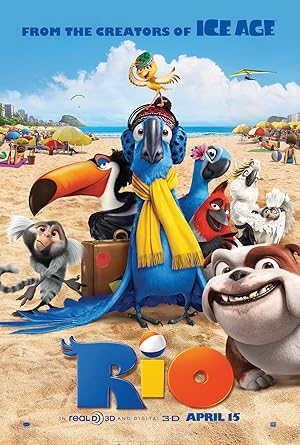
In Rio de Janeiro, baby macaw, Blu, is captured by dealers and smuggled to the USA. While driving through Moose Lake, Minnesota, the truck that is transporting Blu accidentally drops Blu's box on the road. A girl, Linda, finds the bird and raises him with love. Fifteen years later, Blu is a domesticated and intelligent bird that does not fly and lives a comfortable life with bookshop owner Linda. Out of the blue, clumsy Brazilian ornithologist, Tulio, visits Linda and explains that Blu is the last male of his species, and he has a female called Jewel in Rio de Janeiro. He invites Linda to bring Blu to Rio so that he and Jewel can save their species. Linda travels with Blu and Tulio to Rio de Janeiro and they leave Blu and Jewel in a large cage in the institute where Tulio works. While they are having dinner, smugglers break into the institute and steal Blu and Jewel to sell them. Linda and Tulio look everywhere for Blu, who is chained to Jewel and hidden in a slum. Meanwhile, Jewel and Blu escape from their captors and befriend a group of birds that help them to get rid of the chains. It is Carnival and the smugglers and mean cockatoo, Nigel, do not intend to give up Blu and Jewel, and chase the birds through the crowded streets.
Get the Weekly Woke Watchlist
New and trending movies scored for woke bias, preachy messaging, and forced political themes — before you waste your evening.
No spam. One useful email per week.
Overall Series Review
Categorical Breakdown
The central narrative focuses on a bird's journey of self-actualization and learning to fly, not on human intersectional power dynamics. The film depicts a 'colorblind' society in the background, including a positively portrayed multiethnic family unit. However, a negative racial stereotype appears in the casting, as Afro-Brazilians are exclusively depicted in a criminal or hyper-sensual context, such as being the ‘evil favela bird-smugglers’ or dancers in the carnival.
The movie’s primary thematic conflict establishes a clear 'Noble Savage' trope. Minnesota/America is portrayed as a place of comfortable, intellectualized domestication where the protagonist is stifled, awkward, and flightless. Brazil is romanticized as the 'natural haven' where freedom and vitality reside, and where the protagonist can only find his true self and learn to fly. The Northern, technological environment is framed as suppressing the bird's natural, wild instincts.
The female lead, Jewel, is initially portrayed as the capable, free-spirited, and fiery survivalist, while the male lead, Blu, is the bumbling, intellectualized bird who must be taught. This dynamic follows a 'Girl Boss' trope where the female is superior in competence and teaches the male. This is partially countered by the story's ultimate goal and resolution, as the plot centers entirely on the goal of mating to save the species, culminating in the couple forming a traditional family with a 'brood' of children.
The narrative adheres to a normative structure. The entire plot revolves around pairing the last male and female of a species to save it, explicitly celebrating traditional male-female pairing and procreation. The human storyline also concludes with a male-female coupling that adopts a child. The film contains no evidence of alternative sexual ideology, gender theory, or deconstruction of the nuclear family.
The movie does not contain hostility toward religion or a spiritual vacuum. The setting prominently features the Christ the Redeemer statue overlooking Rio. The core conflict is a simple, objective moral battle between good (saving endangered animals) and evil (poaching/smuggling). The smugglers face a clear negative consequence for their objectively wrong actions, reinforcing a sense of transcendent morality over subjective relativism.
Get the Weekly Woke Watchlist
New and trending movies scored for woke bias, preachy messaging, and forced political themes — before you waste your evening.
No spam. One useful email per week.