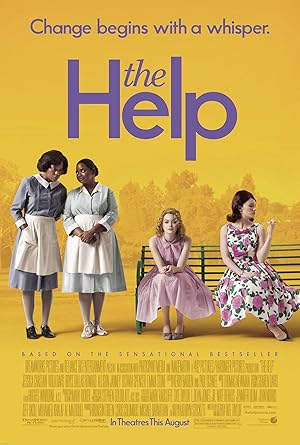
The Help
Plot
Set in Mississippi during the 1960s, Skeeter (Stone) is a southern society girl who returns from college determined to become a writer, but turns her friends' lives -- and a Mississippi town -- upside down when she decides to interview the black women who have spent their lives taking care of prominent southern families. Aibileen (Davis), Skeeter's best friend's housekeeper, is the first to open up -- to the dismay of her friends in the tight-knit black community. Despite Skeeter's life-long friendships hanging in the balance, she and Aibileen continue their collaboration and soon more women come forward to tell their stories -- and as it turns out, they have a lot to say. Along the way, unlikely friendships are forged and a new sisterhood emerges, but not before everyone in town has a thing or two to say themselves when they become unwittingly -- and unwillingly -- caught up in the changing times.
Get the Weekly Woke Watchlist
New and trending movies scored for woke bias, preachy messaging, and forced political themes — before you waste your evening.
No spam. One useful email per week.
Overall Series Review
Categorical Breakdown
The core of the plot is explicitly based on racial and class hierarchy in 1960s Mississippi. The narrative structure is widely seen as a 'white savior' trope, centering the aspirations and moral awakening of the white protagonist, Skeeter, over the autonomy and voices of the Black women. The Black characters are frequently drawn as virtuous figures whose merit is juxtaposed against a society that systematically oppresses them. Many white characters, particularly the main antagonist Hilly, are vilified as hateful and incompetent, with their moral failings tied directly to their social position.
The film extensively portrays the white Southern American culture and its institutions, specifically the social elite and local government, as fundamentally corrupt, racist, and hypocritical. The narrative's primary goal is to expose and condemn the systemic failures and moral rot of this home culture. The Black maids are consistently presented as the repository of authentic wisdom, moral goodness, and superior maternal care, establishing a clear 'Noble Savage' dynamic against the depraved 'civilization'.
Gender roles are analyzed through a specific lens: the white society wives are shown as weak-willed, cruel, or neglectful mothers, whose lives are 'pointless' and consumed by trivial pursuits. The Black maids, though victims of oppression, are presented as 'perfect' surrogate mothers whose nurturing compassion is celebrated. The main protagonist, Skeeter, is an aspiring journalist who rejects the traditional role of a Southern housewife for a career, aligning with the idea that professional fulfillment is superior to domestic life. Male characters are largely irrelevant, bumbling, or absent.
The film is a historical drama focused on race and gender dynamics in the American South during the 1960s Civil Rights era. There is no representation, centering, or discussion of alternative sexualities, gender identity, or queer theory as part of the narrative or theme. The structure of family life, even if dysfunctional or critiqued through the mothers, adheres to the normative structure of the time period.
Faith is presented as a strong, positive force for the Black characters who are experiencing oppression. A major protagonist is explicitly described as a devoted servant of the Lord. A sermon in a Black church acts as the catalyst for Aibileen to take the courageous step of telling her story, affirming that faith is a source of strength and higher moral courage. While the white antagonist Hilly is a hypocritical churchgoer, the narrative does not attack religion itself, but rather the failure to live up to its transcendent moral law.
Get the Weekly Woke Watchlist
New and trending movies scored for woke bias, preachy messaging, and forced political themes — before you waste your evening.
No spam. One useful email per week.