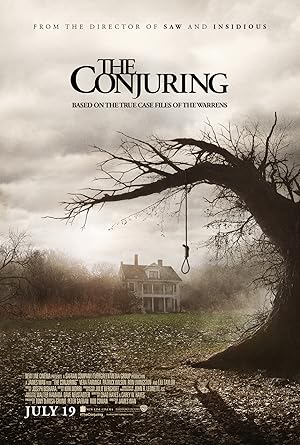
The Conjuring
Plot
In 1971, Carolyn and Roger Perron move their family into a dilapidated Rhode Island farm house and soon strange things start happening around it with escalating nightmarish terror. In desperation, Carolyn contacts the noted paranormal investigators, Ed and Lorraine Warren, to examine the house. What the Warrens discover is a whole area steeped in a satanic haunting that is now targeting the Perron family wherever they go. To stop this evil, the Warrens will have to call upon all their skills and spiritual strength to defeat this spectral menace at its source that threatens to destroy everyone involved.
Get the Weekly Woke Watchlist
New and trending movies scored for woke bias, preachy messaging, and forced political themes — before you waste your evening.
No spam. One useful email per week.
Overall Series Review
Categorical Breakdown
The film centers on two white, traditional families and is set in 1970s New England, a historically accurate representation of the setting and time period. The plot exists to establish a moral conflict, not to lecture on privilege or systemic oppression. Character merit is universal, based on spiritual strength and courage against a purely evil entity. No forced insertion of diversity or vilification of 'whiteness' occurs.
The film does not frame its home culture or Western civilization as fundamentally corrupt or racist. While the historical evil (the witch Bathsheba) is tied to the land's colonial past, the narrative ultimately champions institutions like the nuclear family and Christian faith as the necessary tools to confront the past's darkness. This promotes a view of family and church as shields against chaos, not as the source of it.
The core dynamic is a complementary partnership: Ed Warren (the male) acts as the demonologist and physical protector, while Lorraine Warren (the female) acts as the powerful psychic and emotional anchor, whose unique ability is essential for the family’s salvation. The demon's goal is explicitly anti-natalist (forcing the mother to commit infanticide), and the mother is saved when Lorraine appeals to her powerful, protective maternal instinct, celebrating motherhood.
The story is entirely centered on the survival and defense of the traditional nuclear family (the Perrons) and the traditional married couple (the Warrens). Alternative sexualities or gender ideology are not present, referenced, or centered in the narrative. The structure is one of traditional male-female pairing as the standard against which the demonic force is measured.
Faith is presented as the singular, necessary solution to the central problem. The climax, an unauthorized exorcism performed by Ed Warren, is an overt display of Christian doctrine and ritual defeating a purely spiritual, objective evil, directly opposing moral relativism. Ed and Lorraine Warren's devout Catholic faith is their source of strength and authority, making the film a strong vehicle for transcendent morality.
Get the Weekly Woke Watchlist
New and trending movies scored for woke bias, preachy messaging, and forced political themes — before you waste your evening.
No spam. One useful email per week.