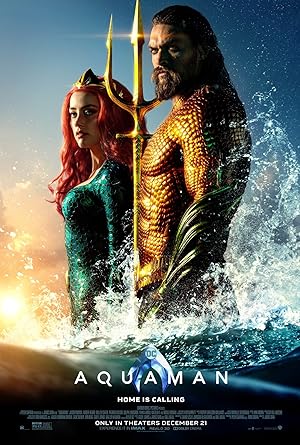
Aquaman
Plot
Born upon the shores of the surface world, Arthur Curry (Jason Momoa) discovers that he is only half human, with the other half of his blood being of Atlanteean descent, thus making him the rightful heir to the throne of the undersea kingdom of Atlantis. However, Arthur learns that Atlantis is being ruled by his malicious half-brother Orm (Patrick Wilson), who seeks to unite the seven underwater kingdoms and wage war upon the surface. With aid from Nuidis Vulko (Willem Dafoe) and the gorgeous Mera (Amber Heard), Arthur must discover the full potential of his true destiny and become Aquaman in order to save Atlantis and the surface from Orm's evil plot.
Get the Weekly Woke Watchlist
New and trending movies scored for woke bias, preachy messaging, and forced political themes — before you waste your evening.
No spam. One useful email per week.
Overall Series Review
Categorical Breakdown
The entire central conflict is explicitly about the hero’s mixed-race 'half-breed' status versus the antagonist's desire for 'racial purity.' The villain, a blond-haired, blue-eyed full Atlantean, repeatedly uses racial epithets against Arthur, whose human father is of Polynesian descent. The hero’s journey is framed as embracing his 'tainted mongrel blood' as a unique source of strength to unite two worlds. The narrative relies heavily on immutable characteristics to define the primary heroic and villainous conflict.
The villain's main motivation for declaring war on the surface world is the pervasive pollution and desecration of the oceans by humanity. Surface dwellers are framed as fundamentally destructive and morally corrupt, justifying the Atlantean desire for war and isolation. This directly places the blame for civilizational corruption onto the 'surface' world, which is a stand-in for Western/human civilization, though the ultimate goal is mediation, not destruction of the surface.
Mera is a 'Girl Boss' archetype who is consistently more knowledgeable, focused, and capable than Arthur through much of the first half of the film, often acting as his rescuer and guide. She drives the plot and handles much of the exposition and tactical execution. However, the film also celebrates a traditional family unit, with the hero's parents being a protective father and a Queen/mother who sacrifices herself for her family. The film ultimately retains a traditional patriarchal structure with a male hero claiming the throne, albeit with a highly competent female partner.
The movie contains no explicit LGBTQ+ themes, characters, or ideological messaging. The relationships presented are heterosexual, and the primary family unit of Arthur's parents is portrayed in a positive, traditional light as the emotional anchor of the hero's life.
The conflict is based on a quest for a mythical, magical artifact—the Trident of Atlan—that can only be wielded by one who is 'worthy' and pure of heart, which represents a search for objective moral and spiritual authority. The primary moral law is about being a hero who fights for 'everyone' and accepts his destiny. There is no hostility toward traditional religion, nor are there any anti-Christian tropes; the spiritual element is rooted in high-fantasy mythology.
Get the Weekly Woke Watchlist
New and trending movies scored for woke bias, preachy messaging, and forced political themes — before you waste your evening.
No spam. One useful email per week.